
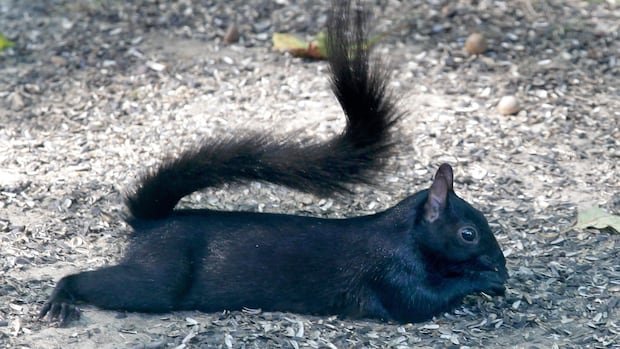
Francis Quang-Hai Dinh spent his first summer at McGill University exploring Montreal’s parks on his bicycle, observing and documenting over 800 grey and black squirrels in nearly 200 green spaces spanning from Mirabel to Saint-Bruno. What initially began as an undergraduate assignment evolved into a personal project to investigate how the city’s layout and meandering waterways influence evolution subtly.
Dinh, who is currently pursuing integrative biology at the University of Illinois Urbana-Champaign, relied on his bicycle due to limited transportation options in suburban regions. His unique approach made him the sole researcher known to conduct manual squirrel surveys park-by-park throughout the area.
The study revealed that approximately 12% of squirrels in Montreal are black, with a higher prevalence of black squirrels observed in northern regions. In areas just north of Laval, up to 40% of squirrels exhibited black coats, while on the island of Laval, around 20% were black. Comparatively, on the island of Montreal, the figure stood at approximately 15%, dropping to 2-3% on the south shore.
The research highlighted three primary factors contributing to the distribution of black squirrels, with temperature emerging as the most significant influence. The cooler climate in northern areas favors black squirrels due to their enhanced heat absorption capabilities compared to grey squirrels. Additionally, the density of forest cover plays a role, as black squirrels blend better in darker environments created by a denser tree canopy.
Senior author Allison Roth, an assistant professor at the University of Missouri, emphasized that the study focuses on using squirrels as a model to explore how urban environments drive evolutionary changes. Montreal’s distinctive characteristics, such as diverse neighborhoods, varying tree cover levels, and natural boundaries like the St. Lawrence River, create nuanced environmental conditions that lead to genetic and physical adaptations within the local squirrel population.
Contrary to previous studies that generalized wildlife changes in urban versus rural settings, this research delves into neighborhood-specific variations. It challenges the notion that human development alone propels these transformations, highlighting the multifaceted influences of urban sprawl, local temperature alterations, reduced tree cover, and natural barriers like rivers.
The study, titled “Fine-scale spatial variation in eastern grey squirrel melanism across a complex urban landscape,” underscores the indirect impact of urbanization on melanism through environmental factors like vegetation structure and winter microclimate. Published as part of a special feature by ecology journals, it contributes to understanding how researchers leverage data and collaboration to address significant ecological inquiries.
Reflecting on his experience, Dinh emphasized the interconnectedness of city life and wildlife, stressing that nature continues to thrive alongside urban developments. His newfound perspective underscores the coexistence of wildlife amidst human modifications to the environment.