
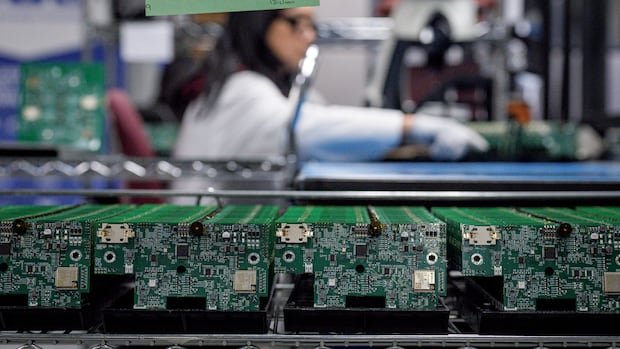
During the ongoing trade tensions between Canada and the U.S., CBC photographer Evan Mitsui has been documenting the impact on businesses in southern Ontario facing new tariffs. Businesses dealing with items like furniture, live flowers, and circuit boards affected by the tariffs express a common sentiment: “Uncertainty.”
Saeid Mohmedi, the founder of MIS Electronics Inc. in Richmond Hill, Ontario, with over 25 years of business experience, acknowledges the unprecedented challenges posed by the current situation. Talking about the next few months for his company, Mohmedi expressed concerns due to the unpredictable nature of the trade environment.
MIS Electronics specializes in manufacturing printed circuit boards (PCBs) for clients in various sectors, including automotive and electronics. While Mohmedi’s primary clients are Canadian companies, they export products to the U.S., making Canadian content a crucial factor in the equation.
The escalating costs and complexities in the supply chain have added pressure to Mohmedi’s business operations. Despite sourcing many components from Taiwanese companies, the indirect route through the U.S. has become longer and more expensive, affecting their production processes and forecasts negatively.
Situated in the tech manufacturing hubs of Markham and Richmond Hill, Ontario hosts a thriving industry specializing in PCB production. While large multinationals like Siemens and Celestica cater to enterprise electronics needs, companies like MIS focus on fulfilling business-to-business orders in bulk quantities for various devices, such as handheld radios, EV chargers, and medical equipment.
MIS, with its 70 employees and a significant manufacturing space, represents the typical small-to-medium-sized business that is vulnerable to the repercussions of the trade conflict initiated by the U.S. The recent Section 338 tariffs, particularly targeting Canadian-made PCBs at a high rate of 50%, directly impact companies like MIS, putting them at risk.
Looking ahead, Mohmedi emphasizes the importance of supporting domestic manufacturing to mitigate the effects of the trade war. He advocates for onshoring supply chains and promoting Canadian-made products as a cost-effective alternative to imports from the U.S. Mohmedi has taken a proactive step by establishing another company producing touchless faucets using MIS parts, all manufactured locally, aiming to fill a gap in the market and promote Canadian goods.
In the face of adversity, Mohmedi sees a potential silver lining in boosting the demand for Canadian products and fostering a self-reliant manufacturing ecosystem. He believes that prioritizing local production can lead to cost savings and economic benefits, ultimately shaping a more resilient and sustainable business landscape.