
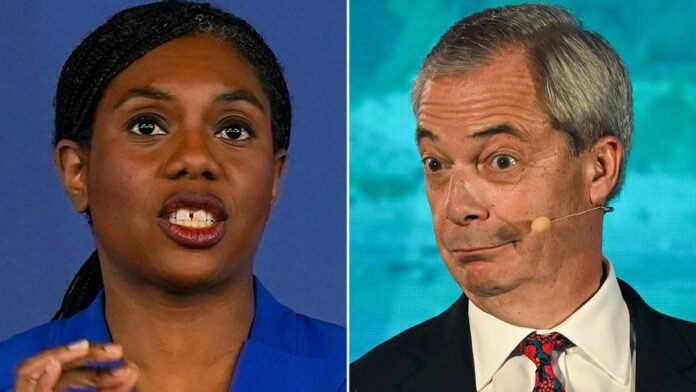
In a hypothetical scenario where Nigel Farage or Kemi Badenoch held the position of Prime Minister during the US and Israel’s military strikes on Iran, Britain would have been close to two weeks into a potential conflict. This observation has been used by Keir Starmer to challenge the inconsistency in the opposition leaders’ positions on the Middle East crisis.
Following the initiation of US-Israeli airstrikes, Kemi Badenoch strongly criticized the Prime Minister for his perceived inaction, while senior Reform officials initially supported British intervention in the conflict. However, both the Tories and Reform parties now seem to be retracting their earlier stances.
The confusion within the Conservative camp came to light during a tense briefing post-Prime Minister’s Questions on Wednesday, where Badenoch’s spokesperson repeatedly asserted the party’s readiness for war when questioned about joining the conflict. On the other hand, Nigel Farage reversed his position abruptly, stating his opposition to involvement in another foreign war on Tuesday.
This shift has exposed both parties to criticism for appearing indecisive and behaving like “armchair generals.” It has also provided an opportunity for Labour to highlight the weaknesses in Reform’s foreign policy approach and criticize Badenoch’s aggressive stance.
A letter signed by over a dozen MPs with military service backgrounds, including former royal marine and Labour MP Alex Ballinger, has been presented to challenge Badenoch’s comments belittling the efforts of RAF personnel in the Middle East. This letter, endorsed by Labour and Liberal Democrat MPs, calls for an apology from Badenoch for her remarks.
Furthermore, there has been a backlash against the Tories and Reform for their shifting positions on the conflict, with concerns rising over the economic impact of the escalating tensions. Public opinion has also turned against the US military action, with opposition to the strikes on Iran increasing by 10 percentage points since the conflict began.
Labour has seized upon the inconsistencies in the foreign policy stances of Reform and the Tories, emphasizing Keir Starmer’s steady leadership in contrast to the opportunism displayed by the opposition parties. The potential consequences of committing British troops to war have been highlighted, emphasizing the gravity of such decisions for the country’s security and the lives of service personnel.