
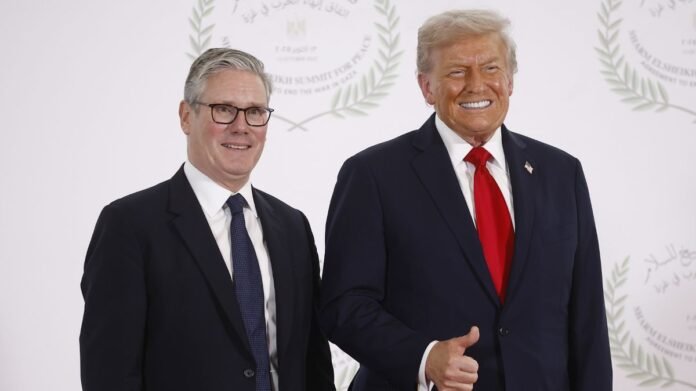
Keir Starmer engaged in discussions with Donald Trump regarding the contentious Ukraine peace initiative today, cautioning that further refinement was necessary. The US President presented a time-sensitive ultimatum to Ukraine to respond to the proposal aimed at resolving the conflict with Russia. However, the Prime Minister and other global leaders expressed the view that the plan, which includes territorial concessions and military reductions for Kyiv, required “additional work.”
Following the talks between Coalition of the Willing partners at the G20 summit, Starmer and Trump agreed to collaborate on refining the peace proposal on Sunday. A spokesperson from Downing Street disclosed that their respective teams would work jointly on the 28-point US peace plan in Geneva the following day, with the leaders scheduled to reconvene for further discussions.
Furthermore, the Prime Minister updated Ukrainian President Volodymyr Zelenskyy on the ongoing negotiations, reaffirming the UK’s unwavering support. In a collective statement issued by Starmer and other G7 leaders, excluding the US, a strong emphasis was placed on the principle that “borders must not be changed by force.”
During a conversation with Mr. Trump, a Downing Street representative conveyed the deliberations among Coalition of the Willing partners at the G20 summit. The leaders concurred that their teams would collaborate on the US peace proposal in Geneva the next day. Trump and Starmer are scheduled to have another discussion on Sunday.
In an earlier briefing in Johannesburg, the PM expressed anticipation of communicating with the US President in the near future. Starmer confirmed that he had no immediate plans to visit Washington DC, emphasizing the urgency of discussions in Geneva the following day.
Urgent talks involving officials from the US and Ukraine are set to take place in Switzerland, with the US president’s special envoy Steve Witkoff and US secretary of state Marco Rubio in attendance. The UK’s National Security Adviser Jonathan Powell will participate in the Geneva discussions after departing the G20 summit prematurely. Representatives from France and Germany are also expected to be present.
Trump has set a strict deadline of November 27—Thanksgiving in the US—for Ukraine to respond to his proposal. The 28-point blueprint to address Kremlin aggression has raised concerns in Kyiv and European capitals. Ukrainian President Zelenskyy highlighted the dilemma of choosing between defending national sovereignty and maintaining vital US support.
The US plan entails Ukraine ceding territory to Russia, a stance strongly rejected by Kyiv, along with downsizing its military and blocking its NATO aspirations. While offering limited security assurances to Kyiv, the plan aligns with several longstanding Russian demands. Starmer and a coalition of 12 European and international leaders welcomed the US peace efforts, acknowledging the need for further refinement to ensure a sustainable and just peace.
The statement emphasized the importance of not altering borders through coercion and expressed reservations about the proposed limitations on Ukraine’s armed forces, which could leave the country vulnerable to future threats. Coordination and support for Ukraine from the EU, NATO, and other partners were underscored in the joint declaration.
Issued alongside the UK, the statement was endorsed by France, Germany, Japan, Canada, Italy, Norway, the Netherlands, Spain, Finland, Ireland, the EU Commission, and EU Council. Former British Army commander Hamish de Bretton-Gordon criticized the peace plan as impractical, asserting that it favored Putin’s aggressive actions without benefiting Ukraine.
In response to the leaders’ statement, he stressed the need for extensive additional work to address the complexities of the situation. Russian President Vladimir Putin cautiously welcomed the US proposal, suggesting it could serve as a foundation for a final peace accord.