
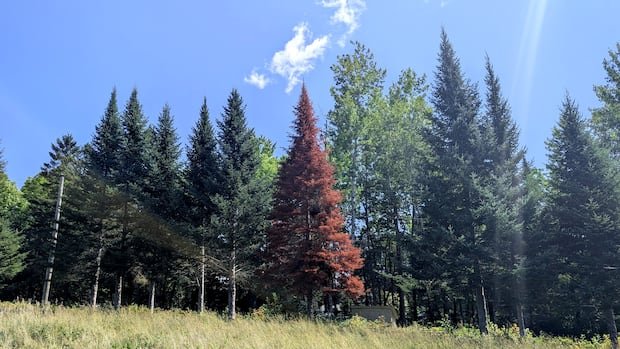
Balsam fir trees in New Brunswick are undergoing a distressing transformation, with their needles turning red and the trees dying off due to the severe drought experienced last summer. Concerns are rising about the future of these iconic trees in the region.
Prof. Anthony Taylor, a forestry researcher at the University of New Brunswick, has been closely monitoring the situation. He has received reports from woodlot owners and witnessed the damage firsthand. The once vibrant evergreen trees, often sought after as Christmas trees, are now wilting and succumbing to the effects of the drought.
According to Taylor, the current scenario aligns with his observations from past hot and dry summers. The warm and dry conditions, like those experienced last year, have significantly hampered the balsam fir trees’ growth capabilities.
Having studied the impact of climate change on New Brunswick’s forests for an extended period, Taylor highlights that similar die-offs of balsam fir trees followed previous instances of unusually hot and dry weather in 1986 and 2018.
The trees are halting their photosynthesis process prematurely in response to the drought, impeding their growth cycle. This disruption means they are no longer producing the necessary energy stores for basic functions and defense mechanisms, making them vulnerable to stressors like insects or pathogens, which can lead to increased mortality rates.
With shallow root systems, the balsam firs struggle to access sufficient water during prolonged dry spells, further compounding their challenges. Woodlot owner Peter McKeil has already noticed significant damage on his property, with trees exhibiting red needles from bottom to top. He estimates a loss of around 100 trees so far and has adjusted his harvesting practices to salvage remaining fir trees before they perish.
McKeil emphasizes that given the escalating impact of climate change, the future looks bleak for the balsam fir species, particularly in southern New Brunswick. He anticipates that the trees may need to adapt or migrate northward to survive.
Taylor views the current situation as a stark reminder of the urgent need for climate action. He hopes that the visible effects on the balsam fir trees serve as a wake-up call, prompting society to transition away from fossil fuels, curb excessive deforestation, and accelerate efforts to combat climate change before irreversible damage occurs.