
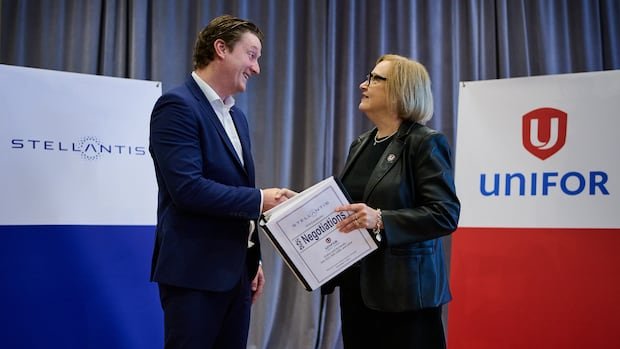
The labor union representing Stellantis workers in Canada cautioned the American automaker against undervaluing Canadian employees as contract discussions with Unifor commenced on Tuesday. Unifor is in the final phase of negotiations with the Detroit Three automakers and typically establishes terms through pattern bargaining for the automotive sector.
Despite recently finalizing collective agreements with Ford Motor Co. and General Motors in Canada, Unifor’s national president, Lana Payne, emphasized that the upcoming negotiations present significant challenges. Payne acknowledged the hurdles faced during uncertain times, including trade wars and tariffs, expressing anticipation for tough negotiations.
A key focus for the union is job security following the layoffs of over 2,000 employees at Stellantis’ Brampton assembly plant, which has been inactive since 2023. Discussions are scheduled to conclude by September 11, with job security being a primary concern for Unifor amidst the plant’s uncertain future.
Recent developments indicated a possible closure and sale of the Brampton plant by Stellantis, prompting concerns from the union. Payne emphasized the importance of retaining production at the plant, particularly regarding the transfer of Jeep Compass production to the U.S., which was deemed a violation of the existing collective agreement.
Stellantis underscored the significance of the labor talks for its future, acknowledging the evolving industry landscape due to trade and regulatory changes. The company’s chairman emphasized their substantial investments in Canada since 2022, highlighting their commitment to the Canadian market and future sustainability.
Amidst ongoing negotiations, the threat of tariffs impacting the auto industry remains a pressing issue. Unifor stressed the importance of maintaining Canada’s auto sector footprint and resisting potential tariff escalations, emphasizing the need to safeguard the industry’s future in the face of external threats.
Larry Savage, a labor studies professor, highlighted the dual challenges facing Unifor in securing favorable agreements with Stellantis while advocating against trade agreements that could harm the Canadian auto industry. The union’s efforts extend beyond individual negotiations to safeguard the industry’s longevity amidst external pressures.
Unifor recently confirmed overwhelming support for new contracts with General Motors, with revised agreements aligning with wage increases reached with Ford. The ratified agreements aim to enhance wages for production and skilled trades workers, reflecting a unified approach in negotiating with automakers in the industry.