
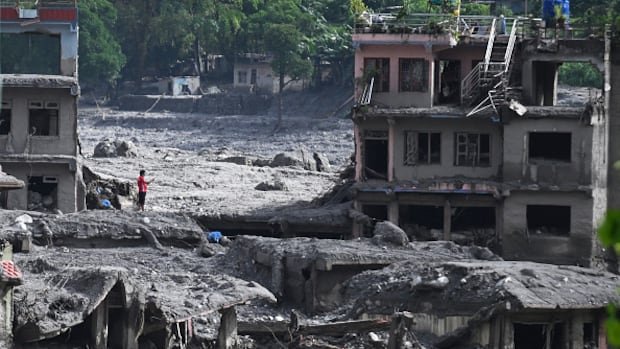
Rescue teams, accompanied by search dogs, persisted in scouring mud, rocks, and debris along the Nepal-China border to locate the thousands still unaccounted for after devastating floods ravaged the Himalayan region, resulting in over 1,000 fatalities.
In Kathmandu, while police interred multiple bodies in trenches, Nepal’s disaster agency confirmed 1,003 deaths and 3,916 missing individuals, including 583 foreigners. China’s latest report cited 16 deaths and 546 missing persons, including 261 foreigners.
The immense scale of the August 26 calamity has impeded rescue operations in both nations due to landslides, demolished infrastructure, and severed access to remote regions. Search teams faced arduous conditions navigating unstable terrains and heaps of debris, heightening concerns of a potential surge in casualties as they reach isolated communities.
Rescuers raced against time to reach around 900 workers reportedly trapped in tunnels at hydropower facilities in Nepal post-flooding. Approximately 500 workers were believed to be stuck in tunnels, as per local authorities.
Nepal’s army spokesperson, Brig. Gen. Raja Ram Basnet, disclosed that teams, aided by foreign specialists, were engaged in rescue missions at several hydropower sites. Images released by the army depicted rescue squads entering debris-laden tunnels, wading through mud and water in pursuit of survivors.
On the Chinese front, rescue crews meticulously combed through areas affected by mudslides, focusing efforts around the demolished Gyirong Port border crossing.
In a bid to clear a major highway leading to Gyirong Port, some rescuers utilized heavy machinery while others meticulously searched for life signs amidst rocks and debris gaps. China’s state-run Global Times newspaper reported the ongoing efforts to restore access for essential equipment, personnel, and supplies to reach the disaster-stricken region.
Meanwhile, in a solemn setting in Kathmandu amidst heavy rain, police proceeded to bury numerous bodies in designated trenches near a wooded area. The site was secured with barbed wire, and unknown graves were marked with blue numbered tags.
Nepalese authorities have been laying bodies to rest in temporary graves pending identification, preserving DNA samples, capturing distinctive facial features through photographs, and documenting identifying particulars with each body assigned a reference number for future identification and retrieval by families.
The relief operations have been expanded to reach marooned communities, with over 11,814 individuals rescued thus far. Emergency teams utilized aerial assets such as helicopters to reach cut-off areas where critical infrastructure had been obliterated by floods and landslides.
Foreign Affairs Minister Anita Anand announced a $5 million emergency aid package from the federal government to Nepal and pledged further assistance for the reconstruction endeavors. Anand expressed condolences and solidarity with Nepal’s Minister of Foreign Affairs, Shishir Khanal, mentioning the 30 missing Canadians in a social media update.
Canada dispatched ten officials to Kathmandu, including an RCMP officer and the deputy high commissioner of Canada to India, to bolster the relief efforts. Global Affairs Canada reported that 30 Canadians remained unaccounted for as of Tuesday evening, with the tally subject to change as new information surfaces.
China’s Foreign Ministry spokesperson, Guo Jiakun, confirmed the dispatch of a second relief consignment to Nepal, comprising drones, DNA testing kits, and water purification apparatus. Chinese experts in DNA testing were also deployed to aid in body identification in Nepal.
The catastrophe commenced with a glacial collapse in the Himalayas, triggering floods downstream as large volumes of rock, ice, and meltwater cascaded into valleys. Scientists analyzing satellite data indicated a bedrock failure beneath a glacier, causing a seismic event registering at magnitude 5.2.
Nepal’s Prime Minister Balendra Shah underscored the imperative of addressing climate change in the wake of the disaster, emphasizing the escalating risks posed by climate change in the Himalayan region. Shah called for heightened awareness and international advocacy on climate change-induced disasters.
Filmmaker and drone pilot Manish Maharjan, who traversed from Tibet into Nepal via Rasuwagadhi border crossing shortly before the catastrophic floods, unexpectedly found himself leveraging his expertise to aid in rescue operations along familiar terrain. Maharjan joined forces with the Nepalese army’s rescue mission a day post-floods, utilizing drones effectively to locate stranded individuals in rugged terrains and caves.
While drones proved beneficial in open areas, Maharjan noted the formidable challenge posed by mud-filled tunnels, likening them to squeezed toothpaste tubes devoid of hollow spaces.