
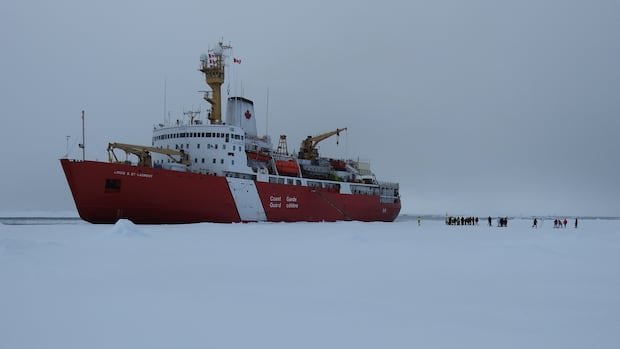
The largest and most powerful icebreaker of the Canadian Coast Guard successfully journeyed to the North Pole this month as part of an initiative to settle territorial disputes in the Arctic. Accompanied by the Swedish icebreaker Oden, the CCGS Louis S. St-Laurent reached the North Pole on August 16.
This polar expedition aims to map the Arctic Ocean floor using specialized sensors to assist in defining Canada’s claim on an area also contested by Russia and Denmark through Greenland. This marks the sixth voyage of the vessel to the North Pole, a location rarely visited by humans.
Captain Byron Briggs, on his inaugural North Pole visit, expressed exhilaration upon reaching the pole’s latitude of 90 North, describing it as a remarkable moment for him and the crew. They even had a rendezvous with Santa Claus at the North Pole and engaged in a friendly hockey game on the ice.
The ship, with a total crew of 77 including core members, medical staff, helicopter crew, and a science team, embarked on the mission from St. John’s, Newfoundland, on July 8 and is anticipated to return in early November. The research conducted during this expedition will support Canada’s claims under the United Nations Convention on the Law of the Sea, particularly concerning the Lomonosov Ridge, a significant underwater feature in the Arctic Ocean.
Kai Boggild, a scientist leading the data collection, emphasized the scientific value of the mission beyond geopolitical implications, highlighting its contribution to understanding the natural history and evolution of the Arctic Ocean over millions of years. The Department of National Defence, through Minister David McGuinty, praised the mission for enhancing Canadian sovereignty, scientific knowledge, and security in the Arctic region.