
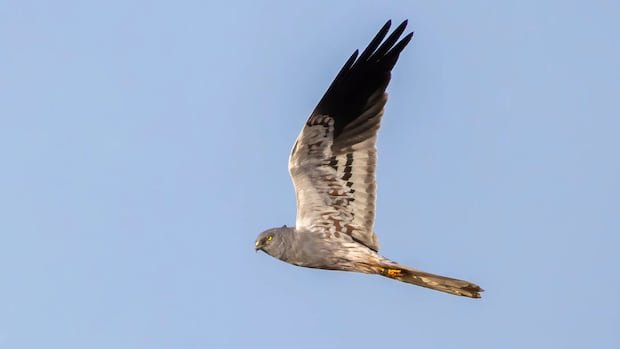
Conservationist Mark Thomas recently revealed in an interview that the survival of a rare bird species in the United Kingdom can be largely credited to the remarkable breeding abilities of a single male. Known as AU, the male Montagu’s harrier has fathered a total of 16 offspring, with 10 born in the past two years alone. Thomas, who leads the species conservation efforts at the Royal Society for the Protection of Birds (RSPB), emphasized AU’s crucial role in sustaining the species in the U.K.
The Montagu’s harriers, a migratory bird species that winters in Africa and parts of Asia before returning to Europe for breeding, are facing global population declines. In the U.K., the birds have been dwindling rapidly, with numbers plummeting from about 30 breeding pairs in the 1950s to zero in the ’70s, then gradually recovering to 13 pairs in the mid-2000s. However, another sharp decline occurred between 2000 and 2003, raising concerns about the species’ survival in the country.
Thanks to AU’s successful breeding efforts, there has been a resurgence in the U.K. population of Montagu’s harriers. In the latest breeding season, AU attracted the attention of three female birds through his impressive aerial displays, ultimately mating with two of them and producing six chicks, evenly distributed between two nests. Conservationists are optimistic that these offspring, including two males from a previous brood, will contribute to the population’s recovery.
To safeguard the new hatchlings, researchers have implemented protective measures around the nests, located in a confidential area on a British farm. The RSPB team, working closely with farmers, aims to ensure the chicks’ safety and monitor their progress. In a significant development, satellite trackers have been attached to two juvenile harriers for the first time, enabling researchers to track their migration patterns and potential return to the U.K. for breeding.
Thomas expressed excitement about the tracking initiative, underscoring its importance in understanding the birds’ behavior and aiding conservation efforts. With high hopes for the young harriers’ future, the RSPB is eagerly awaiting the data insights that will shed light on the juveniles’ journeys and potential impact on the species’ survival.