
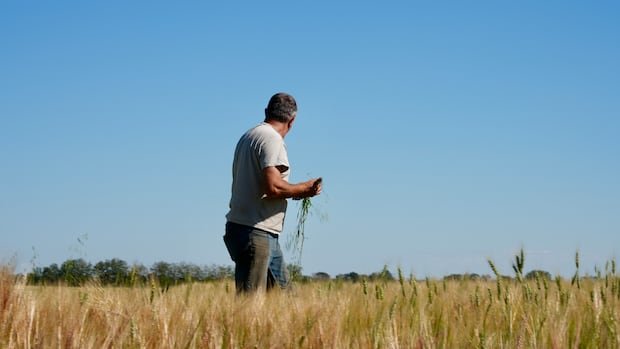
As the harvest season approaches in central Alberta, Kevin Bender is busy preparing his equipment for what appears to be a promising yield. Bender, a grain farmer with a family history of farming 1,300 acres for over three decades, is optimistic due to the timely rains in June that saved the crops from a potentially dry season.
According to Alberta’s latest crop report, major crop yields in central Alberta are expected to be 23% above the five-year average and 20% higher statewide. However, David Lee from Agriculture and Agri-Food Canada’s National AgroClimate Information Service pointed out that while the moisture benefited some farmers, it led to disastrous conditions in northeastern Alberta.
The M.D. of Bonnyville declared an agricultural state of disaster in mid-August after receiving approximately 23 inches of rainfall during the growing season. Several municipalities, including Beaver County, Westlock County, Sturgeon County, and central Wetaskiwin County, have also declared agricultural disasters due to excessive moisture.
Despite the challenges faced by some farmers, Lee mentioned that the weather forecast looks favorable for the upcoming months, with normal precipitation and above-average temperatures expected. This forecast bodes well for the harvest season and agricultural activities in the region.
For farmers like Bender and Jason Lenz, who farm near Bentley, the variability in recent years has made farming unpredictable. While Lenz acknowledges the beneficial rains this year, he believes that sub-soil moisture levels still need replenishing and that drought conditions have not completely subsided.
In areas like Bonnyville, farmers like Dwayne Kalinski and Caleb Fagnan are dealing with the aftermath of excessive moisture, which has affected their crops and livestock. Despite the challenges, Kalinski remains optimistic, hoping for a change in the weather pattern to salvage the remaining crops.
The financial impact of fluctuating weather conditions directly influences farm decisions, according to Bender. A successful crop season may allow for necessary upgrades and investments, while a poor one requires cautious financial planning. Farmers in wetter regions, like Kalinski, are cautiously optimistic about the season’s outcome, hoping for a favorable change in weather conditions for a successful harvest.
As the season progresses, farmers are closely monitoring the weather patterns and crop development, hoping for a positive end to what has been a challenging year for many in the agricultural sector.