
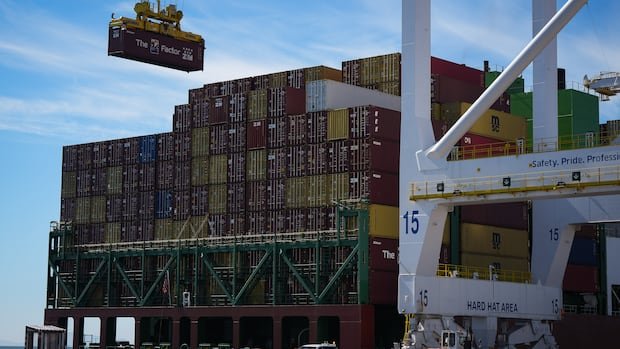
As the clock ticks down for Canada to finalize a trade agreement with the United States, a significant number of Canadian enterprises are feeling anxious, anticipating a potential loss of up to half of their sales if the new tariffs are imposed.
The impending U.S. tariffs are scheduled to become effective on Wednesday unless a last-minute agreement is reached. These tariffs would be in addition to the current U.S. trade restrictions, imposing extra charges on $28 billion worth of Canadian goods, including electronics, dairy products, alcoholic beverages, wood, and more.
Negotiations are reaching a critical stage. It is likely that Canadian officials will meet with U.S. Trade Representative Jamieson Greer prior to discussions between Prime Minister Mark Carney and U.S. President Donald Trump ahead of the tariff deadline on Wednesday, according to a source familiar with the discussions who spoke to CBC News. The ultimate decision on any deal will rest with President Trump, as emphasized by the top U.S. trade negotiator.
The source providing this information to CBC News has chosen to remain anonymous as they were not authorized to disclose details about the negotiations.
For certain Canadian companies, the proposed new tariffs would not only raise prices for American customers but could also render cross-border shipping economically unfeasible.
Todd Stafford, the president of Northern Cables based in Brockville, Ontario, expressed concerns as his company heavily relies on U.S. buyers for approximately half of its sales. Northern Cables specializes in manufacturing copper and aluminum power cables for commercial and industrial applications.
Stafford mentioned in an interview with CBC News on Monday, “We ship 50 percent of our production to the U.S. We have seven warehouses in the U.S. At the announced level of 50 percent tariffs, we would lose all of that business immediately.”
He added, “We can’t have a single tractor-trailer cross the border if the new U.S. tariffs take effect on Wednesday. We’re hopeful that a resolution can be reached, or perhaps an extension of time may be granted.”
Despite having 320 employees in Brockville and avoiding layoffs for the past 26 years, Stafford worries that the tariffs could exacerbate existing challenges like slow condo construction and competition from lower-priced Chinese goods.
CUSMA (Canada-United States-Mexico Agreement) protections will not be applicable in this scenario. Since the beginning of President Trump’s second term in January 2025, he has targeted various sectors of the Canadian economy, including auto parts, lumber, steel, and aluminum.
Although most cross-border trade has been exempt from tariffs under CUSMA, the new tariffs set to be enforced on Wednesday will impact roughly five percent of Canada’s overall trade with the U.S. The affected Canadian exports range from hockey sticks and certain flowers to antiques.
Notably, energy, potash, and critical minerals will remain exempt from the new tariffs.
Jasmin Guénette, the vice-president of national affairs at the Canadian Federation of Independent Business (CFIB), expressed concerns on Monday, stating, “Business owners are extremely apprehensive. Losing 50 percent of your revenue will undoubtedly have a significant impact.”
Guénette highlighted the protective role that CUSMA has played for many sectors and businesses in Canada.
Cindy Baldassi, the owner of CindyLouWho2, a jewelry business in Calgary, shared her worries about potentially losing half of her business due to the new tariffs. She mentioned, “I have now shut down U.S. shipping on my website and my Etsy shop. I’m going to spend the rest of the day adding 50 percent to a substantial amount of my items.”
Baldassi recounted her previous experience of dealing with tariffs and proving her products’ compliance with CUSMA regulations to continue shipping tariff-free to the U.S., an option that is no longer available.
She revealed that she has increased marketing efforts in Canada over the past year but noted that a significant portion of her Etsy shop customers were from the U.S., posing a challenge in expanding her business without a dedicated marketing team or substantial budget.
Guénette highlighted that many businesses in Canada are now looking beyond the U.S. for customer opportunities, citing a growing lack of trust in the U.S. as a reliable trade partner.
Despite the uncertainty surrounding the new tariffs, some business leaders have already felt the impact of the looming threat.
Randy Williams, the director of sales and marketing at Monterey Textiles, mentioned that while their Canadian operations remain robust, they are aware of other textile manufacturers who have faced challenges due to the anticipation of new tariffs