
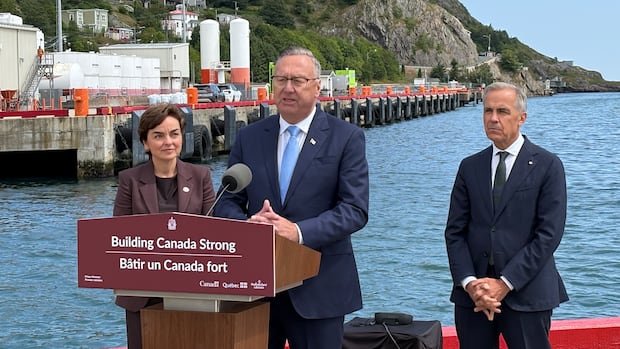
Ottawa has announced what is being hailed as the most significant clean energy investment in North American history. Prime Minister Mark Carney, along with N.L. Premier Tony Wakeham and Quebec Premier Christine Fréchette, revealed a new agreement for Churchill Falls and other electricity projects in Labrador. The leaders gathered on Pier 17 against a stunning ocean backdrop to present the details of the improved deal.
The plan includes a $10 billion investment from Ottawa to enhance the Churchill Falls generating station, develop the Gull Island hydroelectric project, construct transmission lines, and establish a 2,000 MW onshore wind energy project in Labrador. These initiatives, valued at nearly $70 billion, are set to significantly boost the current generating capacity of Churchill Falls, providing enough power to illuminate, heat, and cool all homes in Toronto, Montreal, and Vancouver combined.
The projects are expected to generate 23,000 jobs as per government estimates. The agreement aims to offer Quebec a secure power source while helping Newfoundland and Labrador increase revenue from natural resources to address their financial challenges.
To aid N.L. residents in saving on electricity bills, a new 15% rebate will be granted to ratepayers on their first 2,000 kWh of monthly electricity consumption, resulting in an average annual household savings of $351.
Optimistic Outlook on the Agreement
The revised agreement between Newfoundland and Labrador Hydro and Hydro-Quebec presents updated figures compared to the previous 2024 MOU, with N.L. Hydro indicating an increased value from $36 billion to $49 billion in net present value.
This new deal, valid until March 31, 2027, unless mutually altered or definitive agreements are reached earlier, is being lauded as a triple win by Wakeham. He emphasized the increased power, value, and transmission benefits for N.L., highlighting the state’s control over its resources and economic development choices.
The strategic transmission access arrangement through Quebec guarantees Newfoundland and Labrador the ability to sell up to 985 megawatts of Churchill River electricity, potentially to markets like Massachusetts or New York. This contrasts with the previous MOU, which lacked transmission access assurances for N.L.
Carney emphasized federal investment alongside the Innu Nation for a wind project in Labrador and support for new transmission lines, aligning with N.L.’s provincial anthem’s sentiments about the region’s windswept lands.
Empowering Labrador’s Mining Sector
The additional power is anticipated to foster growth in Labrador’s mining industry, with Ottawa allocating funds to bolster this development. Natural Resources Canada is set to provide over $2.3 million for a transmission line engineering study and $439,844 for preconstruction and feasibility planning for the Kami iron ore project southwest of Wabush.
Political Uncertainty and Future Prospects
Amid an impending Quebec election, questions arise about the agreement’s sustainability under new leadership. Fréchette defended the deal, highlighting its benefits for Quebec and questioning the alternatives proposed by critics. She emphasized the agreement’s job creation potential and the positive impact on both Newfoundland and Quebec.