
In the lobby of a tall building on Fifth Avenue, where the ceiling appeared to have a scheduled tan, I observed a reality TV personality making a grand entrance into the realm of American politics via a golden escalator.
Back in June of 2015, the true gravity of Donald Trump’s emergence was not fully comprehended. It was much more than a mere spectacle; it marked the deliberate unfolding of a perilous strategy. With his White House bid kick-off, he painted immigrants as criminals and portrayed grievances as acts of patriotism. The transition felt like a theatrical performance, almost surreal, as the host of “The Apprentice” ventured into a presidential campaign resembling a season finale.
This was not just a show; it marked the commencement of a calculated political offensive, built on division, fueled by drama, and aimed at perpetuating endless conflict. The reverberations of his actions continue to resonate worldwide, reaching even places like South East Manchester.
Since that pivotal day, Trump has honed a playbook that reshaped modern populism. By positioning himself as the advocate for the “forgotten” Americans while vilifying courts, media, and bureaucrats as corrupt adversaries, he framed his politics as a battle between “the people” and an affluent elite. Immigration was transformed from a policy issue into a cultural battleground, with a border wall symbolizing strength and deportations signaling resolve.
Although he pledged to uplift working families, his legislative accomplishments predominantly favored corporations and the wealthy. While his billionaire associates thrived, many workers struggled with stagnant wages and mounting expenses, if they managed to retain their jobs at all.
Simultaneously, trade disputes were initiated in the name of safeguarding domestic industries, tariffs were imposed, and international alliances were strained under the banner of “America First.” Blaming external forces for setbacks and portraying criticisms as acts of sabotage became the norm. Dissenters, including judges and even Supreme Court members, faced attacks, while loyalty eclipsed expertise. Division ceased to be an unintended consequence; it evolved into the guiding principle of governance, yielding results.
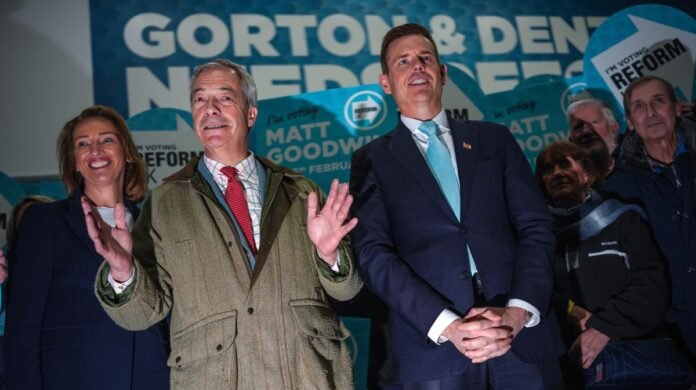
This trend should raise concerns for voters in Gorton and Denton as they head to the polls, as they are not merely selecting between political factions but determining whether a comparable style of politics, rooted in grievances, confrontations, and personal charisma, gains a stronger foothold in their area.
The parallels between Trump’s tactics and the current strategies endorsed by Nigel Farage and Reform UK are striking. Farage, an unabashed admirer of the U.S. president, has emulated Trump’s rhetoric, defending and echoing his language. Viewing Trump’s rise as validation that outrage can be transformed into power, Farage has assembled a team that mirrors this approach.
The individuals surrounding Farage, including businessman Zia Yusuf and political figure Richard Tice, along with disenchanted or realigned Conservative defectors like Robert Jenrick and Suella Braverman, have found a comfortable place within Farage’s circle. As other figures like Andrew Rosindell, Nadhim Zahawi, and Lee Anderson adjust their tone and affiliations, a pattern emerges – a migration not only of individuals but of ideologies.
Their common ground lies less in policy intricacies and more in political opportunities – the allure of the next platform, the next headline, the next step up the ladder. The resemblance in methods is hard to overlook.
Farage, a fervent Trump supporter, has long cultivated an outsider persona, challenging Westminster elites as a plain-spoken insurgent. The Brexit narrative he championed depicted a battle for sovereignty against remote bureaucrats, with themes of betrayal and restoration central to his political persona.
In a move reminiscent of Trump, Farage traversed the Atlantic to criticize his own country on American soil, opting to denigrate Britain abroad rather than advocating his cause at home.
Currently, Reform UK’s messaging revolves around immigration – a core issue akin to Trump’s approach. Their calls for stringent migration cuts, reinforced border controls, and withdrawal from international agreements are pitched as straightforward solutions to intricate problems. In both instances, immigration transcends policy and becomes a symbol of national resolve.
National sovereignty emerges as another shared theme. Trump’s ‘America First’ doctrine prioritized domestic authority over global collaboration, while Farage’s agenda focuses on reclaiming power from European counterparts. Both harbor animosity toward global institutions, arguing that international arrangements disadvantage ordinary citizens.
On trade matters, Trump implemented tariffs, alleging that globalization eroded American industries. Farage, on the other hand, criticized EU trade frameworks and international pacts, advocating for more flexible regulations and enhanced national autonomy. The underlying narrative remains consistent – global systems have failed you; we will safeguard you.
Economically, the parallels sharpen further. Trump slashed corporate taxes and dismantled environmental and financial safeguards, paralleling Reform UK’s advocacy for reduced taxes and extensive deregulation. Both portray limited government as a symbol of liberty, benefiting from financial backing rooted in affluence.
Their stances on energy policy echo each other as well. Trump prioritized