
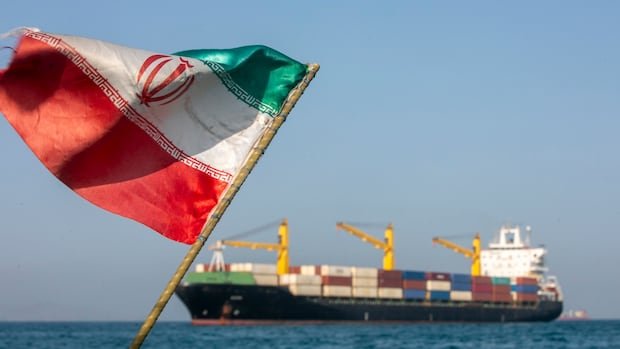
U.S. military forces targeted Iranian rocket launchers in the Strait of Hormuz on Sunday, marking the first military engagement in over a month and breaking a period of relative calm in the ongoing conflict that has spanned more than six months.
According to an anonymous official, Iran’s Islamic Revolutionary Guard Corps (IRGC) were seen preparing to deploy rockets armed with sea mines in the strait. The U.S. military recently completed the clearance of sea mines from the international shipping lanes in the area.
Reports from semi-official Iranian news sources indicated explosions near Larak Island in the strait. Subsequently, Iranian state television broadcast footage of ballistic missiles being launched towards U.S. bases in Jordan in retaliation for the American strikes. The Jordanian armed forces intercepted eight missiles that breached the country’s airspace in the Middle East.
U.S. military officials refuted Iran’s assertion that the strikes were aggressive, describing them as a “limited, precise action” targeting suspected minelaying operations aimed at safeguarding civilian vessels, commercial shipping, and global trade flow. The potential escalation of hostilities in the region poses significant risks as Iran has previously targeted U.S. military installations and infrastructure in Gulf nations since the conflict started on February 28.
The last known U.S. military operation against Iran was on July 29, involving strikes on numerous Revolutionary Guard targets, including coastal defense sites. President Donald Trump subsequently postponed further strikes at the request of Gulf allies Qatar, Saudi Arabia, and the United Arab Emirates.
The recent military action follows a shift in the Trump administration’s strategy towards imposing economic sanctions rather than relying solely on military measures to resolve the conflict with Iran. The emphasis on economic pressure arises amidst concerns over depleted munitions stockpiles following months of sustained conflict, raising apprehensions about the impact on U.S. military readiness globally.
As the confrontation continues, President Trump’s earlier aspirations for a swift resolution appear to be waning. He has emphasized a patient approach to negotiations with Iran, highlighting the administration’s belief in weakening the Iranian leadership. Trump and Israeli officials have lauded the effectiveness of their joint campaign, claiming significant damage to Iran’s navy and air force, with estimates of $270 billion USD in losses to Iran.
Despite the perceived setbacks, Iran retains leverage through its control of the critical Strait of Hormuz, a key maritime passage for oil and natural gas shipments. The ongoing conflict has disrupted traffic in the strait, with Iran capable of targeting vessels using drones and missiles, impacting global oil flow through the region.
While President Trump asserts the continued operation of the Strait of Hormuz, citing recent vessel passages, maritime authorities report reduced commercial traffic levels. An incident involving a tanker ship hit by an unidentified projectile near Khasab, Oman, further underscores the volatility in the strait, with no immediate claims of responsibility or casualties reported.