
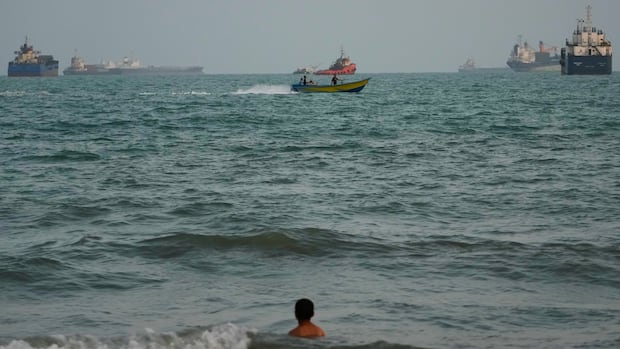
On Sunday, the newly appointed leader of Iran’s Supreme National Security Council announced that Tehran intends to declare an “exclusion zone” outside the Strait of Hormuz, targeting vessels that it suspects are trying to navigate through the waterway.
Mohsen Rezaei’s remarks to the state-run broadcaster provided limited information, following a day after the U.S. military struck three Iranian oil tankers in retaliation for Tehran’s ballistic missile attacks on U.S. naval vessels. Analysts described these missile launches as a troubling escalation, especially after Iran’s earlier assaults on commercial shipping in the region.
Rezaei indicated that the new exclusion zone would be announced in the near future, stating it “will start from the line of the U.S. naval blockade, extending toward the Strait of Hormuz, and continuing into the Persian Gulf.” He emphasized, “Any ship that enters this zone with the intention of passing through the Strait of Hormuz and is identified will be added to our sanctions list.”
It remains unclear how Iran defines the boundaries of the ongoing U.S. blockade, which targets Iranian ports to prevent the country from exporting oil. The U.S. military reported that over 20 warships are actively supporting the blockade, which has redirected 92 commercial vessels and disabled three as of Sunday.
In response to the breakdown of negotiations, the U.S. has been implementing new strategies to intensify economic pressure on Iran, with no resolution to the sporadic conflict in sight.
Iran alleges attack on U.S. vessel, which the U.S. refutes
Simultaneously, Iran has been targeting certain ships attempting to cross the strait, which has become a significant bargaining tool for Tehran amid the ongoing war that began more than six months ago with U.S. and Israeli strikes.
On Sunday, Iran claimed it had attacked an unmanned U.S. vessel attempting to enter the Strait of Hormuz, a statement that the U.S. military rejected as a “complete fabrication.”
This incident marks yet another escalation in the rising tensions between the two nations.
The alleged strike occurred just a day after the U.S. military stated that its forces had targeted three Iranian oil tankers in response to a missile attack on its warships.
The conflict initiated on February 28 with U.S. and Israeli assaults on Iran, but despite the announcement of a ceasefire in June, intermittent fighting has continued, with both parties seeking to inflict military and economic damage as negotiations falter.
On Sunday afternoon, following a weekend filled with attacks, counterattacks, and threats exchanged between the U.S. and Iran, Canada’s Foreign Affairs Minister Anita Anand issued a statement denouncing Iran’s “destabilizing actions.”
“Canada is collaborating closely with allies, including within the G7, to maintain substantial pressure on Iran,” Anand stated.
Attacks resume a week after hostilities reignite
Last week, the U.S. and Iran resumed hostilities after a month of relative peace, with renewed targeting of the Strait of Hormuz and nearby Iranian communities. Earlier in the week, a U.S. airstrike in southern Iran resulted in at least five fatalities.
The Trump administration seems to have adopted a dual strategy in the conflict, responding militarily to attacks on the strait while also targeting foreign financial institutions associated with Iran’s funds.
However, Iran’s new hardline leadership has indicated a determination to withstand the sustained sanctions.
-
U.S. military hits 3 Iranian oil tankers after saying its navy warships were targeted
-
Iran attacks U.S. bases across Gulf after reports of deadly strike on wedding
Over the years, Iran has devised methods to bypass sanctions—now including the U.S. blockade—to sell its oil and alleviate mounting economic strains. This often involves a clandestine fleet that transports its oil.
Concurrently, the nuclear program, which was a contributing factor to the war’s outbreak, was intended to be addressed in negotiations that fell apart shortly after the U.S. and Iran reached a memorandum of understanding in mid-June.
Diplomats indicate that the U.S., alongside Britain, France, and Germany, aims to refer Iran to the United Nations Security Council for its failure to adhere to nuclear non-proliferation commitments.
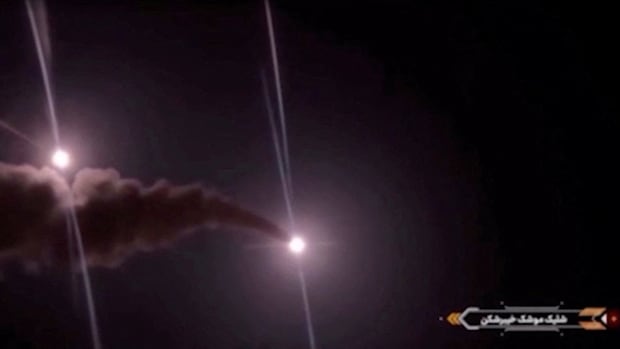
The U.S. launched a fresh round of airstrikes against Iran on Tuesday, following a weekend exchange of fire that broke a month of relative calm in the conflict. Tehran said it responded with missiles and drones on U.S. targets in the region while warning that U.S. attacks would ‘tighten the lock’ on the Strait of Hormuz.
Instead, Tehran’s new strategy emphasizes the Strait of Hormuz, a vital route for global oil and natural gas shipments, which was regarded as an international waterway prior to the onset of hostilities.
Regarding the stalled negotiations with the U.S., Rezaei expressed skepticism not only towards the U.S. but also towards the mediators involved. The memorandum of understanding between the U.S. and Iran signed in mid-June began unraveling within days as both sides accused each other of breaches of agreement.
“We had placed our trust in our intermediaries from Pakistan, Qatar, or Oman, believing that their role as mediators included preventing one side from violating the accord,” Rezaei stated. “We are now seeking diplomacy that includes guarantees.”
U.S. reports 9 million barrels daily flow through strait
The Strait of Hormuz remains essential for global oil and natural gas shipments, having been viewed as an international waterway before the conflict erupted.
On Sunday, U.S. Energy Secretary Chris Wright reported that approximately nine million barrels of oil daily pass through the strait, which should help alleviate energy price pressures.
His estimates seemed to surpass the average flow over the past 28 days through the strait, according to TankerTrackers.com and other sources.
Wright informed CNN that, with oil also being transported through regional pipelines, “we’re likely at two-thirds or more of pre-conflict flows.”
However, these flows rely on the U.S. navy’s presence to escort tankers and provide protection against potential Iranian assaults. Wright anticipated that other nations would eventually back the navy’s initiatives.
In the meantime, during his interview with state television, Rezaei asserted, “Every day, we are selling between one million to one and a half million barrels, as if Iran’s oil production and trade are proceeding as usual.”