
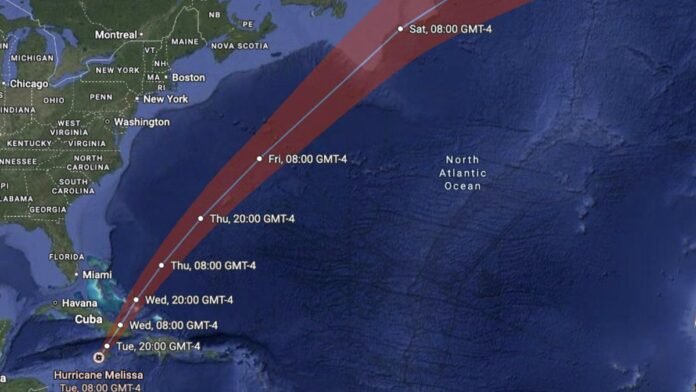
The National Hurricane Center has issued a warning that Hurricane Melissa, the most powerful storm of the year, is on the verge of hitting Jamaica. This Category 5 hurricane, boasting sustained winds reaching 175mph, is currently lashing the Caribbean island with flash floods and storm surges. Although still some distance away, the storm is rapidly approaching, and its eye is anticipated to reach land around midday local time (5pm GMT). Meteorologists are predicting that Melissa could become the most intense hurricane ever to strike Jamaica, bringing with it the potential for up to 30 inches of rainfall and wind speeds of 175mph.
The Met Office has indicated that Hurricane Melissa might impact the weather in the UK. According to a spokesperson quoted in Yahoo News UK, there is a likelihood that Melissa will lose its tropical characteristics in the North Atlantic and disperse as a separate system later in the week. The remnants of Melissa could influence the weather in the UK next week, but the precise impact remains uncertain at this stage. Although significant disruption is deemed unlikely, the system could contribute to the prevailing unsettled conditions across the UK.
Following its passage through Jamaica, Melissa is projected to head towards eastern Cuba by Tuesday evening (12pm GMT). Authorities in Cuba have evacuated over 500,000 individuals from vulnerable areas at risk of flooding and high winds. By Wednesday, Melissa is expected to continue its trajectory towards the Bahamas, where it is foreseen to weaken to a Category 2 hurricane by around 7pm local time (12pm GMT).
Tragically, Melissa has already caused casualties in Jamaica, Haiti, and the Dominican Republic, claiming the lives of three individuals in Jamaica and four in the neighboring countries. The International Federation of Red Cross and Red Crescent Societies estimates that up to 1.5 million people in Jamaica could be impacted by the storm, including around 25,000 tourists currently present on the island.
Experts are cautioning that the climate crisis is exacerbating the intensity of hurricanes in the Caribbean. Climate Central researchers have noted that Melissa rapidly intensified while lingering over ocean waters that were 1.4C warmer than average, conditions that are significantly more likely due to climate change.
The US National Hurricane Center and the World Meteorological Organisation have assigned the name Melissa to this hurricane in adherence to the naming system for tropical storms. These names cycle every six years and are replaced only in cases of particularly catastrophic storms.
To access news promptly, set Daily Mirror as a ‘Preferred Source’ on Google News.
At Reach and across our entities , we and our partners use information gathered from cookies and other identifiers on your device to enhance your site experience, analyze usage patterns, and deliver personalized ads. You can opt out of data sharing and sales at any time by clicking the “Do Not Sell or Share my Data” button on the bottom of the page. Please note that preferences are specific to your browser. By using our website or services, you agree to the use of cookies and consent to the practices outlined in our Privacy Notice and <a data-testid="cipa-terms-and-conditions-notice-link" href="https://www.mirror.co.uk/terms-conditions/" rel="n