
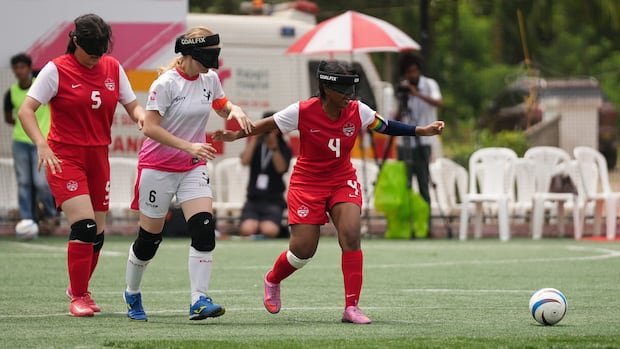
The noise of blind soccer immediately captures attention, with the audible ball equipped with small bells that guide players on the field. Each team comprises five players, all wearing eyeshades to ensure a level playing field. The sighted goalkeeper leads from the back, while a guide behind the opposing net directs attackers. To prevent collisions, players must shout “voy” as they approach opponents.
Canada’s women’s blind national team faces a unique challenge in introducing the unfamiliar sport to Canadians. Over the years, the program has grown, with the team set to compete against Argentina, Mexico, and Brazil at the IBSA Women’s Blind Football American Championship in São Paulo.
Since 2017, the sport has seen significant growth in Canada, with approximately 30 competitive players nationwide. Captain Hillary Scanlon, who unexpectedly lost her vision in 2016, discovered blind soccer online and connected with Matt Greenwood to establish the program in 2022.
Challenges such as limited echo boards in Canada pose safety risks, as experienced by Scanlon during an international tournament in India. The vastness of the country also presents logistical challenges, with players traveling long distances for training sessions.
Canada Soccer’s recent agreement with the Canadian Blind Sport Association marks an important step in supporting blind soccer. The federation now provides administrative support, covers essential costs, and has secured funding to enhance training, coaching, and international competition activities.
Despite the progress, players still need to fundraise or cover their expenses to participate in events like the upcoming tournament in Brazil. The journey from the absence of blind soccer in Canada to a burgeoning national team represents a significant milestone, reflecting the dedication of individuals like Greenwood and Scanlon who have worked tirelessly to make the sport accessible and competitive.