
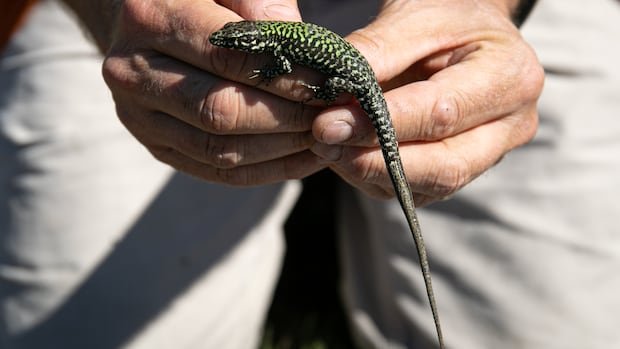
Tracy Menzies had long been battling against slugs in her backyard garden, struggling to outwit them in the race to harvest her produce. However, this year, her strawberries flourished beautifully. The reason for this victory over slugs lies in the presence of the invasive European wall lizard, a fierce predator rapidly expanding its territory and consuming various creatures, including slugs, insects, and spiders.
Living near the Gorge Waterway in Saanich, Menzies observed a surge in wall lizard numbers in her yard recently, observing these small creatures darting around her garden and scurrying under her feet. She attributed the absence of slugs in her garden to the increasing presence of wall lizards, suggesting they might be preying on the slugs.
Gavin Hanke, the curator of vertebrate zoology at the Royal B.C. Museum, estimated the European wall lizard population in British Columbia to be between 800,000 to a million, primarily concentrated on Vancouver Island and spreading northward to places like Campbell River. He expressed concerns about the environmental impact of their rapid proliferation, emphasizing the need to adapt and coexist with these creatures.
These wall lizards, mostly a few inches in size and sometimes reaching up to 10 inches, have become a common sight in various areas. Despite their small size, they pose a significant threat to native species and ecosystems. The absence of official management programs to control their growth raises further concerns among experts like biologist Nicholas Wong.
The invasion of these lizards in British Columbia traces back to a deliberate release of 12 lizards in 1970 after the closure of Rudy’s Pet Park in Central Saanich. Their adaptability to Vancouver Island’s climate and their voracious appetite for invertebrates and fruits contribute to their rapid spread, with a potential to cover significant distances by hitchhiking on various items.
While the wall lizards inadvertently assisted Menzies in protecting her strawberries, she remains cautious about their spreading presence. Hanke suggested maintaining a “boring” garden to deter them, emphasizing the need for collective efforts to manage their population. The curator highlighted that eradication is no longer a viable option due to human interference in ecosystems and the lizards’ adaptability to diverse environments.
Hanke discouraged the relocation of these lizards to new areas, cautioning against their potential further spread. He emphasized the need for responsible actions to prevent their expansion into new territories, foreseeing their potential encroachment into neighboring regions like Washington state in the coming years.