
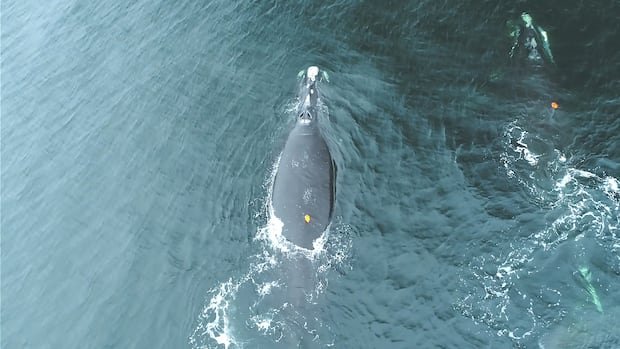
A recent research study has discovered that critically endangered North Atlantic right whales are now engaging in nighttime surface feeding, increasing their vulnerability to boat strikes. Published in the peer-reviewed journal PLOS One, the study highlights this behavior in North Atlantic right whales, offering valuable insights to mitigate fatal collisions between the whales and vessels.
Lead author of the study, Jay Kirkham, a PhD student at Dalhousie University in Halifax, collaborated with the U.S.-based non-profit Ocean Alliance to tag 23 right whales in the Shediac Valley, located in the southern Gulf of St. Lawrence. During summer, a portion of the approximately 384 North Atlantic right whale population congregates in the Shediac Valley for feeding.
Kirkham utilized video footage and data from the tags to monitor the whales’ movements and feeding patterns. He observed that while right whales typically feed near the sea floor during the day, they shift their feeding behavior at night, moving closer to the ocean’s surface where large vessels operate.
By training a machine learning algorithm with his observations, Kirkham identified that right whales feed at a depth similar to that of large vessels at night, heightening the risk of collisions. Collisions with ships and entanglements in fishing gear are major threats to the whale population, underscoring the importance of implementing effective conservation strategies.
Transport Canada and Fisheries and Oceans Canada play crucial roles in safeguarding the right whale population by enforcing protection measures. Fisheries and Oceans Canada emphasized that the study could aid in tailoring management measures for the protection of North Atlantic right whales. Transport Canada, on the other hand, enforces speed restrictions and a vessel exclusion zone in the Shediac Valley during the summer to reduce collision risks.
Despite these protective measures, Kirkham noted that the tagged whales spent a significant portion of their feeding time outside the exclusion zone, exposing them to potential ship traffic. Transport Canada employs a surveillance program utilizing visual and audio detection tools to enhance whale protection and inform precautionary measures in their presence.
The incorporation of the latest scientific research and stakeholder feedback guides the continual refinement of protection measures for the North Atlantic right whales, as highlighted by Transport Canada. This comprehensive approach aims to mitigate threats and support the conservation of this critically endangered species.