
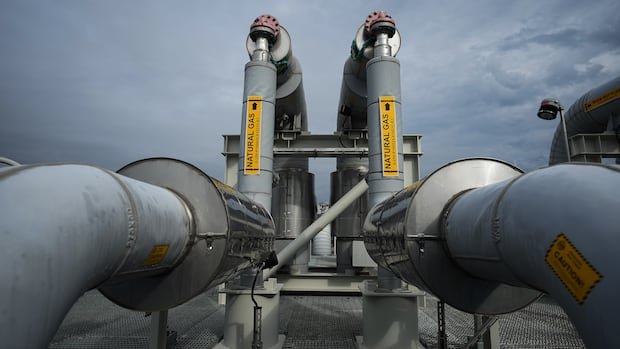
Prime Minister Mark Carney recently emphasized the significant role Canada plays in driving American economic growth, highlighting the country’s export of natural gas to the United States. This raises the question of what would happen if Canada were to cease these shipments.
Although energy products like oil and natural gas have not been used as a bargaining chip in the ongoing Canada-U.S. trade tensions, the idea has sparked debate. Alberta Premier Danielle Smith has consistently opposed this approach, while Ontario’s Doug Ford believes all options should be considered.
Carney noted that the U.S. heavily relies on Canadian energy, with Canada supplying 99% of their natural gas imports, 85% of their electricity imports, and 60% of their crude oil imports. However, while the U.S. imports a significant amount of natural gas from Canada, it only represents a small portion of overall U.S. consumption.
According to Dulles Wang, director of Americas gas and LNG at Wood Mackenzie, Canadian natural gas deliveries to the U.S. account for a small percentage compared to domestic production. He highlighted the intricate network of natural gas pipelines crossing the Canada-U.S. border, playing a vital role in heating homes, generating electricity, and supporting industries in both countries.
Enbridge, headquartered in Calgary, stands as North America’s largest natural gas provider, having completed significant acquisitions in the U.S. market. Wang emphasized that while Canadian natural gas shipments to the U.S. may seem modest in comparison to domestic production, the geographic distribution of these deliveries is crucial.
Halting natural gas exports to the U.S. would have severe economic repercussions for Canada, causing an oversupply situation and plummeting prices. Wang warned that eliminating the U.S. as a customer could be detrimental for Canada’s energy industry, emphasizing the importance of diversifying export markets.
The Canadian government is actively seeking non-U.S. buyers for its energy products. Initiatives like the LNG Canada facility in Kitimat, B.C., which started shipping liquefied natural gas to Asian markets, are part of this strategy. Wang stressed the need for continued support for such projects to reduce dependence on the U.S. market.