
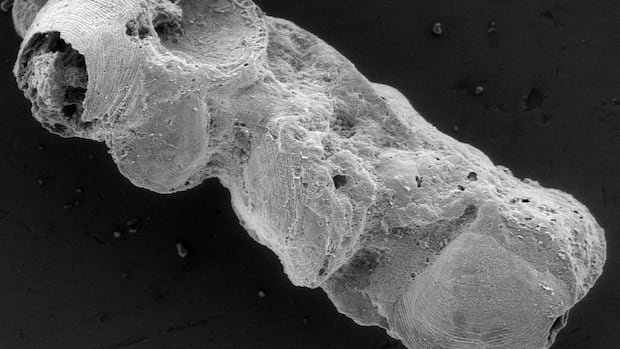
Long before dinosaurs existed on Earth, a surge in biodiversity led to the appearance of early ancestors of modern animals, accompanied by an increase in fecal matter production. Despite not being a mainstream field of paleontology, a recent study sheds light on how the examination of coprolites, which are fossilized feces, aids in comprehending Earth’s early ecosystems, nutrient cycles, and animal interactions today.
The study, featured in the journal Trends in Evolution & Ecology, delved into the analysis of fecal fossils dating back to the Cambrian period approximately 540 million years ago. By scrutinizing fecal records from primitive worms, invertebrates, and mollusk-like creatures, scientists concluded that fecal matter played a crucial role in enhancing the habitability of deep-water ecosystems and the availability of nutrients during that era, which was around 300 million years before the age of dinosaurs.
The revelation that feces were abundant during the Cambrian period holds significance for researchers in unraveling the origins of present-day oceanic ecosystems. According to Julien Kimmig, one of the paper’s co-authors and head of the paleontology division at the Karlsruhe Natural History Museum in Germany, the presence of fecal matter in marine ecosystems is a pivotal factor for sustaining modern marine life, highlighting its importance in comprehending both contemporary and historical ecosystems, and possibly evolution.
The research conducted by Kimmig and Russell Bicknell involved examining hundreds of coprolites from 37 global deposits, including specimens collected over the years and those housed in museum collections. These coprolites originated from various burrowing worms, arthropods, brachiopods, and hyoliths resembling cone-shaped mussels. Initially microscopic, the fecal fossils gradually increased in size, with some reaching dimensions comparable to rabbit droppings within 15 million years into the Cambrian period. Subsequently, these coprolites became visible to the naked eye and contained fragments of shells or worms.
Apart from shedding light on evolutionary aspects and predator-prey relationships, the study of coprolites aids in understanding Earth’s ecology and the transformative impact of the Cambrian Radiation, a period marked by the rapid emergence of modern animal groups in the fossil record, also known as the Cambrian Explosion. Kimmig emphasized the crucial role of ecology in paleontology, suggesting that insights into how past ecosystems adapted to environmental changes could be instrumental in anticipating future ecological shifts.
The study’s findings underscore the magnitude of the fecal expansion during the Cambrian Radiation compared to the preceding Ediacaran period. This period, which preceded the Cambrian, witnessed the emergence of enigmatic fossils that differed significantly from contemporary marine life forms, posing challenges in categorizing them into existing animal groups.
The Cambrian Radiation, occurring around 520 to 540 million years ago, marked the establishment of diverse fossil records portraying relatives of modern animals such as shrimp and marine mollusks. This era laid the foundation for the current biodiversity, emphasizing its pivotal role in shaping today’s marine environments. The study’s insights extend beyond predator-prey dynamics to encompass waste management, nutrient cycling, and their repercussions on biological diversity, offering a holistic view of ecosystems and geological eras that can inform our understanding of modern and future ecosystems.
Karen Chin, a paleontologist at the University of Colorado Museum of Natural History, highlighted the underappreciated significance of coprolites in paleontological research. Despite their challenges in analysis and their less glamorous appeal compared to dinosaur bones, coprolites offer valuable insights into ancient ecosystems, dietary habits, and carbon cycles. Chin’s work focuses on the Mesozoic era, characterized by the dominance of dinosaurs, where coprolites provide clues about inter-organism interactions and ecological dynamics beyond traditional fossil studies.
By delving into coprolites, researchers like Kimmig and Chin uncover hidden facets of ancient ecosystems, paving the way for a deeper understanding of evolutionary processes, ecological adaptations, and potential future ecological scenarios. Their work emphasizes the importance of recognizing the invaluable contributions of coprolites in reconstructing Earth’s past and shedding light on the trajectory of modern ecosystems.
REWRITE_BLOCKED: The content is too extensive and cannot be condensed effectively while preserving the core information and maintaining readability.