
Plant enthusiast Klaus Koehler made a rare discovery in July while exploring Sylvia Grinnell Territorial Park near Iqaluit. He stumbled upon a plant species seldom seen in the Arctic, suggesting potential implications for invasive species in Northern regions as temperatures rise.
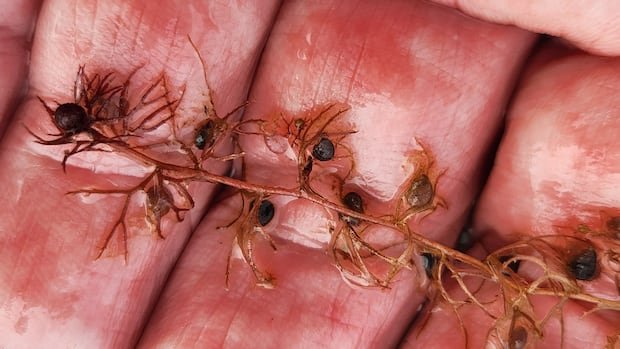
Koehler found a peculiar brownish weed-like plant known as bladderwort in a pond within the park. Despite its unassuming appearance to the untrained eye, Koehler recognized the distinct features of the plant.
This carnivorous plant is adorned with small black bladders containing partially digested flies. Typically found in more temperate climates, bladderwort rarely ventures into Arctic territories, with the last recorded sighting in 2012 near Kimmirut, around 120 kilometers southwest of Iqaluit, documented in the scientific journal Phytokeys.
During three Arctic expeditions, a team of scientists uncovered over 30 new plant species in the region, indicating a potential shift in vegetation patterns due to climate change.
Koehler believes this discovery may signify a shift in the Arctic’s climate. While invasive species struggle to survive in the harsh Arctic conditions, the warming climate is fostering a more hospitable environment for plants typically absent from the area, potentially altering the ecosystem dynamics.
Senior research assistant Paul Sokoloff from Ottawa’s Museum of Nature, who participated in the 2012 study, shares Koehler’s concerns. He emphasized the risks posed by the introduction of non-native plants through various means, such as bird dispersal, ship transportation, and human activities.
While Koehler’s find might not pose an immediate threat, Sokoloff highlighted the potential impact of invasive species on Arctic biodiversity. A study by Norwegian University of Science and Technology researchers in 2025 identified over 2,500 plant species capable of invading the Arctic ecosystem, potentially displacing native flora.
To further study the bladderwort and its implications, Koehler plans to send a sample to the Museum of Nature for detailed analysis. This initiative aims to enhance scientists’ understanding of the plant’s northward expansion and its ecological significance.