

Across Quebec, from college campuses to the garages of Montreal’s Metro system, various public institutions are discreetly shutting down prayer spaces and revising staff protocols as the province’s new secularism legislation is fully implemented.
Law 9 greatly extends the provisions of Bill 21, introducing further restrictions.
Initially enacted in 2019, the ban on religious symbols now also affects daycare personnel, with prayer areas prohibited in locations such as university grounds and transit agency facilities like the Société de transport de Montréal.
However, as institutions hurry to meet these new requirements, administrators and legal professionals caution that the government has left them to maneuver through a complicated legal grey area, lacking clear instructions on how to enforce these regulations.
The enforcement of Law 9 commenced on September 1.
Closure of Prayer Rooms, Chapels Remain Open
Concordia University, which previously offered a sizable prayer room, as noted by the Muslim Student Association, has stated that it no longer provides any designated spaces for prayer.
McGill University has also expressed its commitment to adhere to legal requirements. Dawson College opted not to provide a comment.
“All signage has been removed,” stated Ezekiel Montoya Desjardins, vice-president of external affairs at the Dawson Student Union, who oversaw the prayer facilities.
With the removal of signs and some furnishings like carpets, the rooms now stand vacant. Montoya Desjardins acknowledges the government’s stance but believes that secularism should not equate to the absence of religious activities.
“I believe it signifies neutrality among all religions within the educational environment,” he remarked, highlighting that the prayer rooms were primarily utilized by the Muslim community, though they were accessible to all.
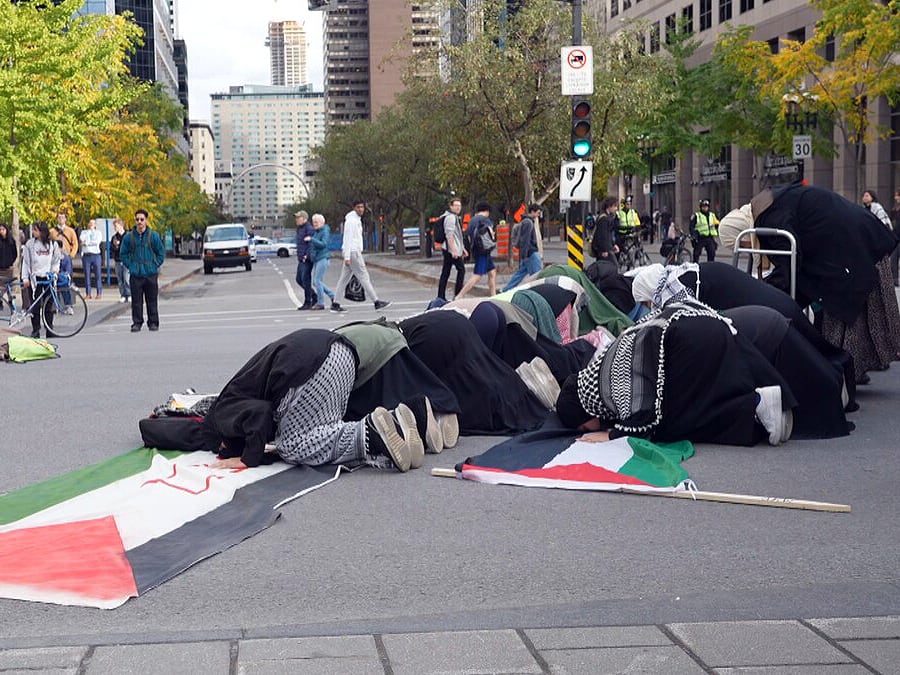
The implementation of Law 9, endorsed by the Quebec government in the spring, restricts public prayers. (Radio-Canada)
At Vanier College, the general director Benoit Morin reported that a small prayer room had been secured since early August. A sign on the door instructs Muslim students to visit a nearby mosque for their prayers.
While these prayer rooms are being shut down, religious activities in chapels at institutions such as Université Laval, Concordia, McGill, and Bishop’s University are still permitted.
Vanier Aligning with Legislation
Morin indicated that the institution is currently addressing two significant components mandated by the new law. The first involves creating a system for requesting and assessing religious accommodations by the administration, followed by setting up a complaints process.
Previously, students approached professors for religious accommodations, but now such requests will be routed to Morin’s office, where he or a designated representative will make decisions.
Additionally, regarding grievances about non-compliance with existing secularism laws, a new registry for Law 9 complaints needs to be established, which will be subject to auditing by the ministry, he explained.
The institution has also developed new training for security personnel to familiarize them with Law 9 and to caution individuals if they witness any non-compliance.

New regulations are being implemented today under Law 9, which is the latest expansion of Quebec’s secularism laws. Researcher Sarah Jesmer from Let’s Go explains the concrete changes affecting locations such as schools, daycares, and the STM.
Morin noted that the new policies are hindering Vanier’s ability to teach students the significance of coexisting peacefully.
“It’s been and continues to be quite challenging to clarify how this should function within Vanier’s environment,” he remarked. “We have exerted considerable effort over the summer to ensure compliance.”
There is hope that educational institutions like Vanier will have more input before such laws are enacted in the future, as they “greatly affect communities developed over many years,” he added.
Daycare Union Monitoring Compliance Closely
The law also prohibits employees in subsidized daycare centers and private schools from wearing religious symbols, although those currently employed are exempt from these restrictions.
A representative from the federation for health and social service workers is examining the implications for its 13,000 daycare workers across 400 subsidized facilities.
In a statement, Lucie Longchamp, spokesperson for the Fédération de la santé et des services sociaux-CSN, mentioned that they have requested their member daycares to assess the effects of Law 9 and the federation “will diligently observe developments in the upcoming weeks.”

Lucie Longchamp serves as the spokesperson for the Fédérations de la santé et des services sociaux-CSN. (Radio-Canada)
She stated that the federation anticipates feedback regarding service disruptions, employee turnover, and recruitment challenges. They will provide further commentary based on those insights.
The spokesperson also affirmed that the FSSS-CSN will continue to “advocate for an inclusive, pluralistic model of secularism that does not compromise the provision of non-profit educational services.”
STM Shuts Down Prayer Area, Revises Policies
Montreal’s public transportation authority has informed its workers that they can no longer pray on company property.
The Société de transport de Montréal (STM) has designated four rooms for employees to engage in quiet activities such as meditation or yoga, but these spaces are no longer permitted for prayer.
The agency indicated that notices have been placed outside these rooms to remind staff of the prohibition, and supervisors are instructed to address any religious practices observed.
The union representing maintenance staff at the STM chose not to comment.
Within the transit system, musicians may continue to express their beliefs through song and wear whatever attire they choose, but they are not allowed to “manifest any religious practice” or conduct worship services through music in the Metro.
STM spokesperson Amélie Régis stated that special constables, now trained under the new regulations, will intervene if any performers in the Metro engage in praying or evangelizing.

The union for professionals such as engineers and architects noted that there are resource rooms designated for prayer within STM garages. (Graham Hughes/The Canadian Press)
Groups like Jehovah’s Witnesses will still be permitted to operate, including discussions about their beliefs with individuals. Since they do not impose their beliefs on others but rather wait for engagement, the STM will not restrict this activity.
“It is our understanding that discussing a belief does not constitute a religious practice,” she explained.
Régis mentioned that constables will enforce compliance by “prioritizing an awareness-raising approach,” issuing warnings to individuals who fail to adhere to the regulations.
Attorney Identifies a ‘Grey Area’
The fines stipulated under Law 9 typically range from $125 to $1,125.
The legislation outlines the enforcement mechanism, which includes inspectors authorized to enter institutions, take photographs, and report findings.
Nonetheless, it remains the responsibility of employers to ensure adherence to the law.
Frédéric Bérard, a constitutional lawyer, indicated that Law 9 signifies a considerable extension of governmental oversight and the measures being enforced.
“You could argue that it goes far beyond Bill 21,” Bérard noted. “One must consider the underlying objective of this action.”
He argued that the government is unable to provide tangible instances of public prayer within the Metro leading to any disturbances, suggesting that the legislation is more political maneuvering than a response to genuine issues.
While Bill 21 focused on figures in authority such as educators and law enforcement to limit state influence, Bérard indicated that expanding restrictions to cafeteria staff, custodians, and transit workers signifies an effort to eliminate visible religious expression entirely.
“What could be the next step?” he queried. “Are we going to prohibit Muslim women from wearing veils in public? Will we take it that far?”
Bérard added that public institutions are compelled to navigate a legal grey area, lacking explicit guidelines on enforcement or how to address non-compliant employees.
There are no instructions on handling situations where an employee refuses to comply.
“What actions should we take regarding individuals who persist in wearing their religious symbols? Should we terminate their employment? How do we approach that?” Bérard questioned. “These institutions are unclear on what actions they must undertake to comply with the new law.”
CBC News has reached out to the office of the minister responsible for secularism and was informed that a response is forthcoming. The article will be updated accordingly.