
Nearly a quarter of a century has passed since the people of Gander and surrounding areas in Newfoundland and Labrador welcomed thousands of stranded airline travelers following the September 11 attacks.
Their kindness has been the inspiration for various books, films, and the musical Come from Away, but this was not the first instance of Newfoundlanders and Labradorians extending their hospitality to those in need during crises.
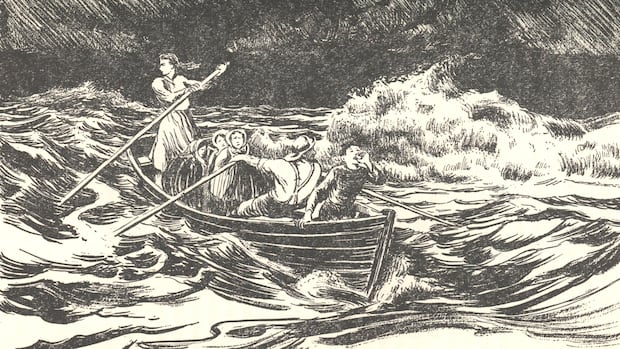
One night in July 1828, fisherman George Harvey was strolling along the desolate beach in Isle aux Morts when he noticed a keg bobbing in the waves, indicating that a ship had likely sunk nearby.
At first light the following day, he took his 17-year-old daughter Ann and 12-year-old son Tom aboard his small boat and set out to find the wreckage.
After several hours, they discovered the Despatch. The vessel had hit a rock, but most of its two hundred passengers had made it to a reef, where they were huddled together against the elements “like sea birds.”
For three days, the Harveys tirelessly rescued the passengers, bringing them to safety one by one in their boat.
However, their efforts did not end there.
For two to three weeks, while awaiting the arrival of a relief ship, the Harvey family provided care for the 163 survivors in their home and temporary shelters.
As noted by surveyor Joseph Jukes, who stayed with the Harveys a decade later, their food supplies “were so completely exhausted, that [they] were compelled to live chiefly on salt fish, with neither bread, flour, butter, nor tea, during the whole of that winter.”
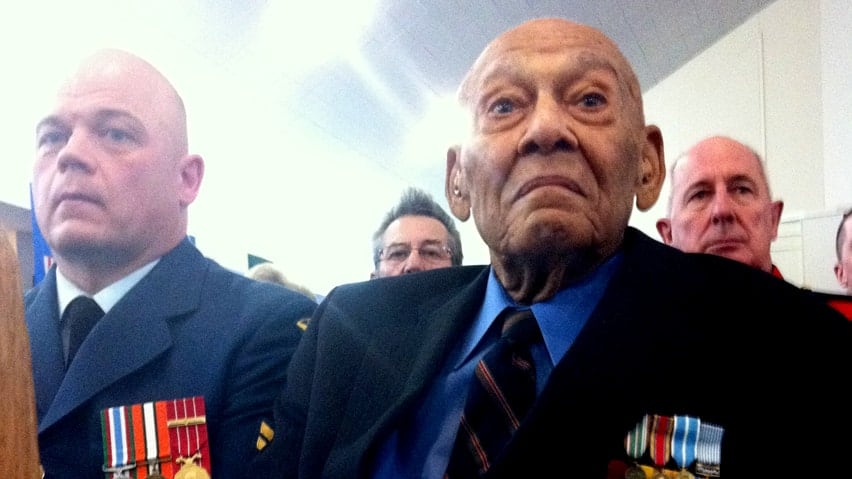
Lanier Phillips’ experience being treated the same way as white survivors after the sinking of the USS Truxton near St. Lawrence inspired him to become a civil rights activist. (CBC)
Another maritime disaster during World War II had significant consequences. In February 1942, the American destroyer USS Truxtun ran aground on the Burin Peninsula, prompting eighteen-year-old Black sailor Lanier Phillips to leap into the icy, oil-slicked waters.
He later regained consciousness in the small community of St. Lawrence, where local residents had laid out the survivors on tables, removed their soaked clothing, and were cleaning the oil from their skin.
Having been raised in Georgia under the influence of the Ku Klux Klan, Phillips admitted he felt more apprehensive being naked around white women than he did when he jumped into the ocean.
“One lady held my hand,” he reminisced, “and she said, ‘Gee, this poor fella… the oil is all in his pores.’”
Phillips responded, “That’s the color of the skin. You can’t wash it off.”
The woman, Violet Pike, had never encountered a Black man prior to this. She brought Phillips to her home, fed him soup, and helped him settle into bed.
“I had always thought that all Caucasians were racists and bigots,” Phillips reflected. “Well, they showed me there were individuals in the world who were not.”
This experience motivated Phillips to combat segregation and pave the way for Black sailors in the U.S. Navy.
In 1957, he became the navy’s first Black sonar technician and later pursued a pioneering civilian career as an oceanographer. He was also involved in the civil rights movement, marching alongside Martin Luther King Jr. in Selma, Alabama.
In his later years, Phillips traveled across North America, sharing his story about that night in St. Lawrence, his professional journey, and his vision for racial equality.

Hundreds of people had to be evacuated from Terrenceville in September 1961 due to the Dunn’s River wildfire. (Evening Telegram/Memorial University Digital Archives Initiative)
Two decades after the USS Truxtun disaster, Newfoundlanders faced a mass evacuation due to devastating wildfires in 1961.
The town of Terrenceville on the Burin Peninsula was engulfed in smoke. While local men remained to combat the fire, 450 women and children were transported in the dead of night to Bay L’Argent.
Telegraph operators worked tirelessly overnight to coordinate the rescue, while every car owner in the Marystown area was roused to drive 60 kilometers to collect the evacuees.
“Within one hour 40 cars were on the road,” reported the Evening Telegram, “and in less than three hours 200 evacuees had gathered in Marystown’s St. Gabriel’s Hall, where they were provided with hot beverages and sandwiches.”
Once nourished, the evacuees were welcomed into private residences in Marystown, Fortune, and Grand Bank.
At that time, Marystown’s mayor E. P. Reddy described the community’s response as a “spontaneous outpouring of generosity toward a neighbor in urgent need.”
Unaware of the events that would unfold in 2001, Reddy mistakenly believed that such an act “might never be surpassed in the history of our island.”
-
Current N.L. wildfires reminiscent of the devastating summer of 1961
-
Gander’s generosity on 9/11 is getting the Heritage Minute treatment by locals
Is Newfoundland and Labrador truly more welcoming than other regions?
Many cultures value hospitality. The ethical responsibility to assist strangers in distress is part of what enables human societies to thrive and adapt.
However, this does not imply that all cultures display hospitality similarly. Some societies prefer a formal approach to hospitality, where guests are invited and activities are prearranged. In contrast, other communities emphasize spontaneous hospitality, embracing drop-in visitors and unannounced guests.
In her book Foreign to Familiar, Sarah A. Lanier posits that structured hospitality is more prevalent in colder climates, while spontaneous hospitality is often found in warmer regions, as mild weather encourages outdoor gatherings and open-door practices.
Severe environments, where cooperative support is vital for survival, can also cultivate a welcoming disposition.
Among the Bedouin, hospitality is regarded as one of the highest virtues, traditionally practiced in desert regions. Similarly, the unpredictable weather and rugged landscape of Newfoundland and Labrador may have fostered hospitality for comparable reasons.
People living in harsh conditions may also have more chances to exhibit hospitality. The tumultuous North Atlantic has, for better or worse, provided Newfoundlanders and Labradorians with numerous opportunities to assist those who have survived shipwrecks.
Regardless of the cause, tales of strangers receiving a warm welcome in dire situations can encourage everyone, like Lanier Phillips, to recognize the best aspects of humanity.
Download our free CBC News app to sign up for push alerts for CBC Newfoundland and Labrador. Sign up for our daily headlines newsletter here. Click here to visit our landing page.