
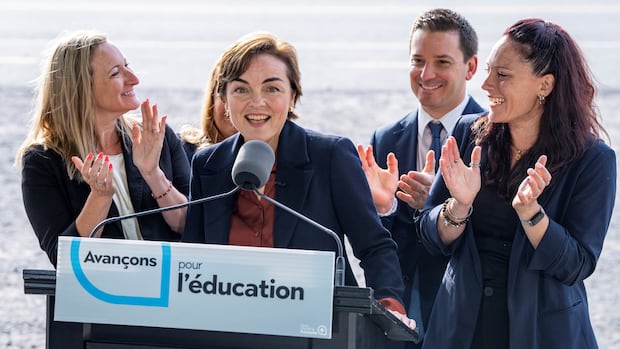
Recently, Coalition Avenir Québec Leader Christine Fréchette made an education-related announcement outside a newly built high school in Saint-Zotique, Quebec.
What caught attention was not just her commitment to contribute $1,000 to the Registered Education Savings Plan (RESP) for every newborn in Quebec, but also her remarks regarding the province’s educational framework.
When questioned about whether she perceived a three-tier system within Quebec’s education, Fréchette replied: “Not really.”
The term three-tier system refers to the various educational paths accessible to students, encompassing subsidized private institutions, public schools with specialized programs, and standard public schools.
Fréchette’s remarks followed the release of a report by Montreal public health officials that detailed how this very system, criticized for its perceived inequities that favor some children over others, aggravates health disparities among youth in the city.
The report indicated that the gaps are particularly pronounced between private and public sectors, as well as within the public system itself, distinguishing between regular and specialized programs.
While regular classes must serve all students, entry into specialized programs and private schools can hinge on a variety of selection criteria, often including academic success and family financial standing.
Public stream students at higher risk of dropping out
Dr. Mylène Drouin, head of Montreal Public Health, shared with Radio-Canada’s Tout un matin that young individuals facing academic challenges and hailing from disadvantaged backgrounds are especially impacted by these inequalities.
“These are the students who suffer the most in terms of their health and their opportunities for post-secondary education,” she stated.
Data for the 2023-24 academic year referenced in the public health report revealed a significant disparity in graduation and qualification rates between private school students (92.5 percent) and those in the public system (79.8 percent).
In a similar vein, students from the most affluent socioeconomic backgrounds achieved higher graduation and qualification rates at 88.8 percent compared to 63.9 percent for their less advantaged peers.
The report concentrated on several key aspects, including experiences within schools, self-esteem, and health and lifestyle habits.
It stated that public school students encounter more challenges across all health indicators than their counterparts in private schools, reporting lower self-esteem, poorer health perceptions, higher mental health diagnosis rates, and less active and nutritious lifestyles.
Drouin also noted that public system students have a threefold higher risk of abandoning their studies compared to those in private institutions.
-
Quebec party leaders talk infrastructure, public schools and tariffs on Day 7 of campaign
-
Education, immigration and cost of living dominate campaign trail on Day 6
The findings of the report raise concerns about the education system’s ability to effectively mitigate social inequalities and uphold the principle of equal opportunity. Drouin emphasized that this situation calls for broader contemplation.
“How can we guarantee that young individuals—whether they struggle academically or come from underprivileged backgrounds—can access quality educational resources, support systems, and an environment that provides them with an equal chance to graduate, while also promoting good mental and physical well-being?”
Time for denial is over, says union
Fréchette’s remarks regarding the education system provoked backlash from multiple union leaders and members of Québec Solidaire, who accused the CAQ leader of lacking awareness.
Ruba Ghazal, co-spokesperson for Québec Solidaire, criticized Fréchette on the campaign trail following the report’s release.
“It’s hard to believe—how can Christine Fréchette be so disconnected from reality? Does public health really investigate and publish reports on issues that don’t exist?”

Québec Solidaire co-spokesperson Ruba Ghazal has stated that the party intends to abolish the three-tier education system if they are elected. (Christinne Muschi/The Canadian Press)
Québec Solidaire has been vocal on this matter, with former co-spokesperson Gabriel-Nadeau Dubois having asserted that the education system in the province is flawed and unjust.
He highlighted private school subsidies and selective programs as contributors to social segregation and advocated for the elimination of the three-tier system. Ghazal has pledged that if elected, the party would follow through on this promise.
Mélanie Hubert, president of the Fédération autonome de l’enseignement (FAE)—which represents approximately 60,000 teachers across nine unions—stated in a press release that “the time for denying the existence of a three-tier education system is over.”
She noted that Drouin’s report serves as another wake-up call for the establishment of a true societal project for public education.
Hubert reiterated the federation’s call for a unified school system—one where public funding for private institutions would necessitate collaboration with or integration into the public education framework.
Where do the parties stand on consultations?
Éric Gingras, president of the CSQ, which represents educators in both private and public spheres, expressed during a press conference on Wednesday that the CSQ was shocked by Fréchette’s denial but integrating private schools into the public system isn’t necessarily straightforward, and the benefits may not be substantial.
He reiterated the need for all political parties to commit to conducting a comprehensive consultation on education, engaging all stakeholders, including those from private institutions.
“Investing in education is not only about making piecemeal announcements; it involves addressing fundamental issues,” he remarked.
When unveiling its education agenda, the Parti Québécois promised to initiate a widespread public consultation within its first 100 days if elected, noting that the last major review of the province’s school system occurred in the 1960s.
Both QS and the Quebec Liberal Party have also indicated they would pursue this goal.
Conversely, the CAQ has opposed the idea, arguing that it would postpone the implementation of necessary reforms.

One week into the provincial election campaign, our weekly election panel takes a closer look at the key developments so far. Le Devoir columnist Emilie Nicolas and CBC News political analyst Antonine Yaccarini break down the events from the past week and look ahead to what could shape the campaign in the days to come.
Private schools launch campaign
In the meantime, the provincial federation of private schools initiated a campaign earlier this week aimed at showcasing the significance of various educational pathways in addressing students’ needs.
The campaign underscores that the private education system does not compete with the public system but rather complements it. Additionally, it seeks to dispel certain misconceptions surrounding funding and selection criteria.
Private institutions, it asserts, cater to students with special requirements, with one out of four primary students and one out of five secondary students having an intervention plan.
The federation also highlights that nearly all private schools operate as non-profits, with government funding linked to students rather than the institutions themselves.