
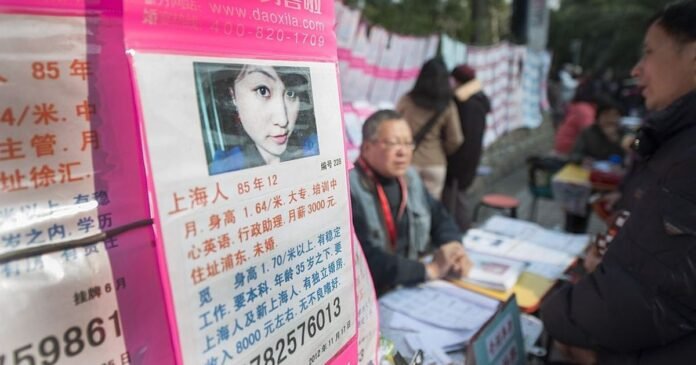
In China, parents are taking charge of finding partners for their single adult children as the country grapples with a decline in marriage rates and birth numbers. This unique approach involves parents gathering at a park in a southwestern city for “xiangqin jiao,” a real-life dating event resembling traditional dating apps.
During these gatherings, parents, mostly retirees, present paper resumes detailing key information about their unmarried children, such as age, gender, height, job, and sometimes weight and income. Some profiles even specify detailed requirements, like desired habits, physical attributes, and age range of potential partners.
This phenomenon stems from China’s historical one-child policy, introduced in 1979 to control population growth. Despite the policy being lifted in 2015, its effects persist, with a gender imbalance favoring men and leading to challenges in finding suitable matches for women who received better education and resources.
To encourage childbirth and address the low marriage rates, the government now offers childcare subsidies. This shift reflects the stark reality where only a small percentage of marriages are registered in a country with a vast population.
Individuals like Zhang Jing, a 34-year-old sales professional, attend these events personally due to difficulties in finding partners who meet their expectations regarding financial stability and homeownership. Meanwhile, men like Huang Weiming, a 36-year-old marketer, participate to find someone who aligns with their values and lifestyle.
Although success stories from these markets are rare, people continue attending, viewing them as social spaces for retirees to interact and discuss societal challenges. The practice, which originated in Beijing in the early 2000s before spreading to other cities, endures as a cultural norm despite its limited effectiveness.
As individuals navigate the complexities of modern dating in China, the tradition of parental involvement in matchmaking persists, offering a glimpse into the evolving dynamics of relationships in the country.