
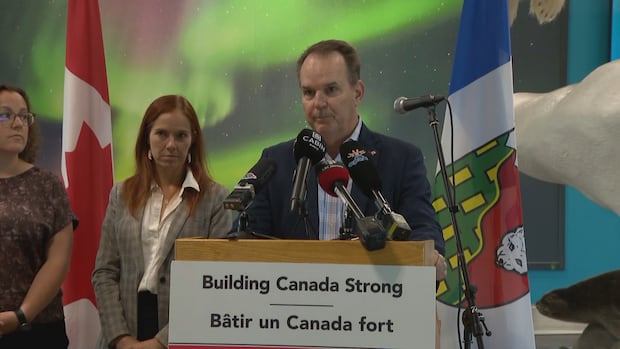
On Tuesday, the federal government revealed a $405-million investment aimed at the Mackenzie Valley Highway, which it claims will be “transformational” for local residents.
The Mackenzie Valley Highway is an all-season route that will link the final segment of Highway 1 at Wrigley to the Dempster Highway in Inuvik. It has been classified as a project of national significance. This roadway aims to diminish dependence on seasonal barge transport and winter roads, while also being positioned as a project that bolsters national defense.
During a press conference held in Yellowknife, federal Transport Minister Steven MacKinnon stated that the highway would open up economic prospects through mineral exploration.
“However, most importantly, it will enhance the quality of life for those residing in the territory,” he remarked.
This funding will facilitate the construction of a bridge over the Great Bear River near TulıÌt’a, advance the second phase of the Prohibition Creek Access Road, and carry out preliminary engineering and design for two further bridges across the Liard and Mackenzie rivers. Moreover, the funds will assist in completing the environmental assessment and design for the segment of road linking Wrigley to Norman Wells.
Caroline Wawzonek, the N.W.T. minister overseeing strategic infrastructure, energy, and supply chains, stated that the construction of the Great Bear River bridge would generate substantial employment opportunities.
“We need all residents who are ready, willing, and able to be employed during the construction stages,” she emphasized.
Wawzonek noted that groundwork, quarry preparation, and gravel work would commence this winter while the government seeks a contractor for the bridge. She anticipates that construction will begin in early July 2027.
She also mentioned that the territory is collaborating with communities to prepare for a potential increase in substance abuse and the demand for emergency services that may arise from improved highway access.
This funding is part of a $1-billion Arctic Infrastructure Fund unveiled last year. MacKinnon acknowledged that the $405 million would not cover the entire project but expressed a desire to fund the next phase of the highway promptly.
A more dependable Mackenzie Valley corridor is expected to enhance the resilience of Canada’s northern transportation system and bolster the country’s long-term presence, security, and sovereignty in the Arctic, as noted in a press release on Tuesday.
Additionally, the investment aims to fortify regional supply chains, enable year-round community resupply, improve access to health and emergency services, and provide safer, more reliable transportation for residents and Indigenous communities.