
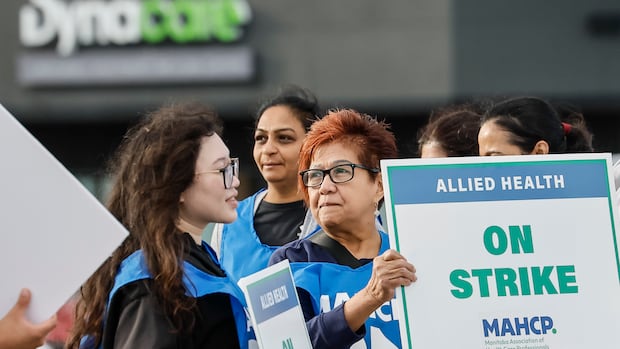
According to their union, the Manitoba Labour Board has mandated that hundreds of Dynacare employees return to their jobs.
The Manitoba Association of Health Care Professionals announced on Tuesday afternoon that the 350 affected workers must report back to work on Wednesday. This directive follows a ruling made by the labour board on the same day that lab technicians and technologists at the private company initiated a strike.
Union president Jason Linklater expressed to CBC’s Up to Speed host Faith Fundal that the 350 laboratory technicians and technologists are extremely frustrated. “They are outraged with this government’s decision to force them back to work, infringing on their right to strike,” he stated shortly after the announcement was made.
On Tuesday, a hearing was held by the labour board to evaluate an application from Manitoba Labour Minister Malaya Marcelino, who sought an interim order for the complete restoration of services while the independent body assesses whether Dynacare employees are delivering an essential service.
“The Manitoba government has sided with a private, American-owned corporation that is taking advantage of front-line healthcare professionals, rather than supporting those workers who are severely underpaid,” Linklater said in the union’s announcement.
This decision signifies “a serious breakdown of trust” in Manitoba’s NDP government; however, the union plans to comply with the order while considering ways to address what Linklater referred to as “government interference.”
In its statement, Dynacare welcomed the ruling to halt the strike, indicating that its workforce would return to their posts and all lab operations would resume as usual starting Wednesday morning.
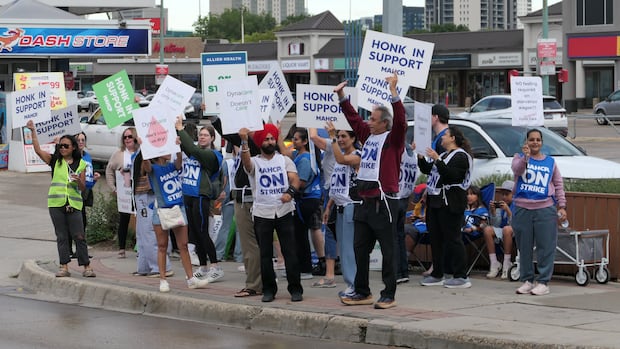
The Manitoba Labour Board ordered 350 Dynacare lab technologists and technicians back to work Tuesday, only hours after the workers hit the picket line. The decision came after the province’s labour minister filed an application asking the board to deem the work essential to prevent a threat to the health, safety and welfare of Manitobans.
“We appreciate the labour board’s swift action to ensure that patients continue to have access to care, and we look forward to having our team back,” stated the company’s email.
The company recognized that “this has been a challenging time for our team” and assured that employees would receive Dynacare’s “full support as they resume providing healthcare services to Manitobans.”
‘Immediate risks’: labour minister lawyer
The lab technicians and technologists began their strike earlier on Tuesday morning after reaching a deadlock in contract negotiations with the company, which led to some delays in diagnostic testing throughout the province.
The provincial government contended on Tuesday that a return-to-work order was essential to avert consequences that may be unaddressable if the strike persisted.
“The risks are immediate, widespread, and irreversible,” asserted Keith LaBossiere, legal counsel for the labour minister, during the hearing.
LaBossiere noted that the strike could cause delays in prenatal and cancer screenings, leave patients on anti-psychotic medication without necessary monitoring, and disrupt mobile collection services that are crucial for preventing infectious diseases.
According to LaBossiere, Dynacare employees handle about 40 percent of all lab testing in Manitoba, which includes approximately half of all phlebotomies (blood collection for diagnosis or treatment) and two-thirds of cytologies (microscopic examinations for diagnostic purposes).
These statistics were derived from affidavits provided by Dynacare and provincial health leadership, with the company warning that it anticipates a backlog of 34,000 patients weekly if services are not sustained.
Dynacare reported an average of 15 critical results arising from routine testing each day in Manitoba, according to the company’s chief medical and scientific officer, Jenisa Naidoo, in the submitted documents.
“It’s evident that Manitobans face significant safety concerns and potential consequences,” LaBossiere remarked, describing the repercussions of a prolonged strike as “catastrophic.”
He indicated that redirecting thousands of patients would exacerbate the already lengthy wait times for healthcare, among other issues.
Union questions timing
Dynacare employees have been operating without a collective agreement since March 31. Earlier that same month, both the union and the company agreed that an essential services arrangement was unnecessary.
During the hearing on Tuesday, the Manitoba Association of Health Care Professionals contended that none of the circumstances that led to that decision had changed.
Union attorney Jake Giesbrecht stated that the union had communicated with the government both prior to and following that ruling.

During the Tuesday hearing, Manitoba Association of Health Care Professionals lawyer Jake Giesbrecht, right, argued against the province’s request to send hundreds of striking Dynacare workers back to work. (Prabhjot Singh Lotey/CBC)
“This issue has been pending for months—six months—and suddenly at the last moment, the minister claims this is ‘catastrophic,'” Giesbrecht remarked during the hearing.
“If this situation were genuinely urgent and critical, why did the government wait six months to take action?”
Dynacare attorney Benjamin Hecht stated remotely that the company would not have consented to that determination if it had encountered the “overwhelming” evidence the province presented on Tuesday, and he apologized for the situation.
Giesbrecht contended that whether Dynacare employees deliver an essential service should be evaluated later, asserting that the province was seeking the “extraordinary” remedy of halting a legal strike without substantiating its necessity.
“This is all speculation,” he stated, highlighting Shared Health’s own public communications indicating that Manitobans might face delays only in medically safe cases, and that there were measures in place to minimize interruptions.
Giesbrecht also proposed that Dynacare could outsource tests for processing as part of its contingency strategies. He mentioned that the province’s 82 laboratories have the capacity to manage the testing needs.
He argued that the province should have provided justification for only addressing the essential services issue after Dynacare employees overwhelmingly voted in favor of a strike.
“The onus lies with anyone opposing the essential worker designation to act swiftly, as people rely on it,” he remarked, adding that the workers initiated the strike based on the understanding that they were not classified as essential.
LaBossiere responded that the law does not specify a timeline for the minister to present such arguments to the board, and there could be various reasons for delays, including the desire to wait until all alternative options had been explored.
“Regardless of what transpired, it does not prevent the minister from making the application,” he stated.
‘Threw them under the bus’: union
After the board’s ruling, union president Linklater commented that if the province is willing to strip Dynacare workers of their right to strike, it could extend that action to other employees as well.
“The government had a chance to back front-line healthcare workers, but instead, they threw them under the bus,” his statement read.
A representative from the province stated that the government has a fundamental duty to ensure essential healthcare services, which is why it requested the labour board to review the situation.
The province also encouraged Dynacare to return to the bargaining table, according to the statement.
Following the decision, Dynacare expressed its commitment to achieving a fair and equitable agreement with the union.
Negotiations for a new contract began in February, but no tentative agreement has been reached since mediation started in July.
Dynacare’s last proposal was presented to the union the previous Friday, which the union stated did not adequately address the wage disparity with public-sector lab workers.
According to a news release issued last month, lab employees showed overwhelming support for strike action, with a 99.7 percent vote in favor.
In its statement released on Tuesday, Dynacare asserted that the company has “put forth multiple strong offers” and proposed binding arbitration as part of the negotiations.