

On Sunday, the far-right Alternative for Germany (AfD) achieved a significant victory in a regional election, but narrowly missed the opportunity to secure a majority, hindering its aim to establish the first far-right state government in Germany since World War II.
Chancellor Friedrich Merz’s party, which has faced unpopularity, experienced a catastrophic outcome in the eastern state of Saxony-Anhalt.
The AfD’s gubernatorial candidate proclaimed, “We have made history,” asserting that the party has received a clear mandate to lead.
Ulrich Siegmund, 35, stated during an interview with public broadcaster ARD that the electorate has communicated that “the status quo is unacceptable.” He remarked that “Friedrich Merz was a very effective campaigner for us in this election.”
-
Analysis
Germany’s AFD could become 1st far-right party to hold state power since WWII. What could that mean?
-
Analysis
65 years after the Berlin Wall was built, Germany’s east-west scars help feed a rising far-right party
The AfD aimed to secure an absolute majority in the state assembly to govern independently and dismantle the so-called firewall that prevents mainstream parties from collaborating with it.
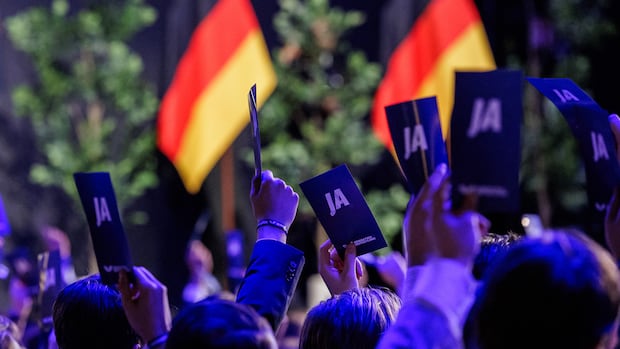
For the first time since the Nazi era, a far-right German political party is eyeing victory in the state of Saxony-Anhalt. For The National, CBC’s Marina von Stackelberg goes there to find out how Alternative for Germany (AfD) went from fringe to frontrunner.
The final results indicated that AfD fell three seats short of the majority, securing 39 representatives in an 83-member assembly. Siegmund stated that the party would not partake in “games” such as forming a minority government. However, it remained unclear how the fragmented opposition could establish a stable government without the AfD’s involvement.
A Setback for Chancellor Merz
The establishment of a state government would represent the most significant achievement in the AfD’s 13-year existence, coinciding with growing dissatisfaction towards a national government that has struggled to convince the electorate of its ability to revitalize the sluggish economy.
Regardless of whether the AfD ultimately takes the reins, this outcome represents a setback for Merz, whose center-right party has governed Saxony-Anhalt for the past 24 years.
In contrast to many European nations, contemporary Germany has yet to see a far-right or right-wing populist party lead a national, state, or major city government.
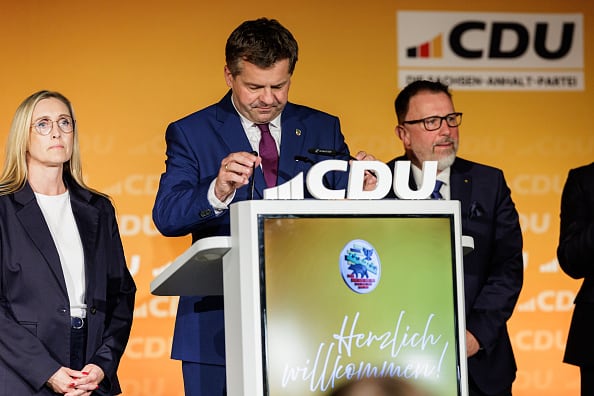
Sven Schulze, the premier of Saxony-Anhalt and member of the German Christian Democratic Union (CDU) reacts to initial results in Saxony-Anhalt state elections on Sunday. (Jens Schlueter/Getty Images/Getty Images)
The AfD is currently the most popular party in Germany at the national level and is working to secure a foothold for promoting its policies, which include stringent restrictions on immigration, re-establishing relations with Russia, reducing support for Ukraine, and exiting the euro.
An ARD survey revealed that 87 percent of voters in the state expressed dissatisfaction with the federal government. Siegmund has portrayed Merz as the AfD’s most effective campaigner, citing his unpopularity in the region.
Marcel Fratzscher, president of the German Institute for Economic Research, stated, “This election result is, above all, a vote of no confidence in the federal government,” in comments made to Reuters.
Merz, leading the center-right Christian Democratic Union, has pledged to revitalize the largest economy in Europe through business-friendly reforms and increased spending, while cautioning that an AfD victory in Saxony-Anhalt would harm the state and discourage foreign investments.

Officials prepare absentee ballots for the Saxony-Anhalt state elections in Magdeburg, Germany, on Sunday. (Liesa Johannssen/Reuters)
Mainstream parties in Germany have collectively refused to collaborate with the AfD, which has been classified as a right-wing extremist group by the country’s domestic intelligence agency.
An exception is the small Sahra Wagenknecht Alliance party (BSW), which appears poised to meet the threshold for parliamentary representation. The BSW has suggested the possibility of a non-partisan state premier managing Saxony-Anhalt by relying on shifting majorities, including support from the AfD.
However, Siegmund dismissed the BSW’s proposal as a “mess” and declined any arrangements with other parties that would obstruct the AfD from fulfilling its promise of change. “If it comes down to it, new elections will simply be held,” he stated.
-
Germany’s AFD could become 1st far-right party to hold state power since WWII. What could that mean?
Merz’s conservative faction indicated they would consider discussions with other parties, which may require aligning groups with significantly divergent policy positions. In the neighboring eastern state of Thuringia, the conservatives operate a minority government with passive support from the Left party.
Despite being one of the smaller German states, with a population exceeding two million, the results in Saxony-Anhalt emphasize the rapid rise of the AfD since its founding in 2013.
According to a recent INSA poll, the AfD is currently the most favored party in Germany, with a support rate of 28 percent, comfortably ahead of the conservatives at 20 percent.
Strict Stance on Immigration
While hard-right parties have gained traction across Europe, Germany’s historical context with Nazism has fostered hesitance among mainstream parties to engage with the AfD.
The AfD has rejected claims of extremism, labeling them as fearmongering and an affront to its millions of supporters.
Throughout the campaign, the AfD capitalized on the growing disenchantment with established political parties, which it depicts as worn out and disconnected, presenting instead a series of stringent policies and a nostalgic outlook focused on a return to safer, cleaner streets and pride in German identity.
“It is evident that we need transformation in Germany and in Western Europe. And I believe a signal for change is certainly emerging from here—whether it is welcomed or not,” remarked Antony Lee, a participant at the AfD’s election gathering. “As a father and entrepreneur, I recognize that the current situation in Germany is untenable.”
The AfD’s agenda includes initiatives to steer educational institutions and cultural bodies towards what it considers more traditional values, while imposing restrictions on immigration and reforming public broadcasting. It proposes segregated classes for refugee children.
Additionally, the party advocates for a ban on rainbow flags in schools and insists that the German national flag should be displayed daily. It also calls for the national anthem to be sung by students and staff during school events. Other suggestions include citizen patrols, increased Russian language instruction in schools, and a moratorium on constructing new wind farms.