
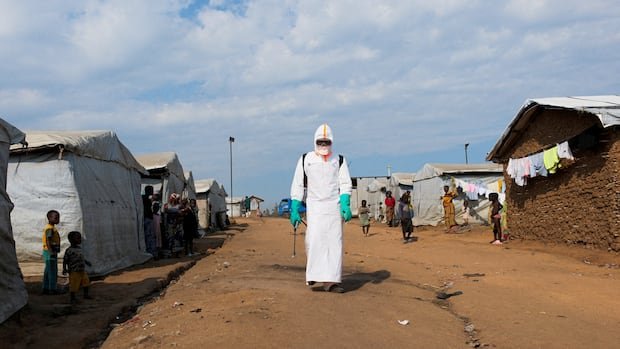
Parents and educators in the heart of the Ebola crisis in the Democratic Republic of Congo are requesting authorities to postpone the reopening of schools due to the ongoing surge in infections that surpass containment efforts.
The Ebola outbreak, centered in the eastern province of Ituri, is experiencing unprecedented growth and remains uncontrolled, with Congolese health officials reporting 5,713 confirmed cases and 2,744 fatalities.
Africa Centres for Disease Control and Prevention officials highlighted a continuous rise in weekly cases and deaths in Ituri and the neighboring Nord Kivu province, expressing concerns that the true scale of the outbreak might be significantly larger than reported figures.
Kyeng Mercy, a public health strategist and epidemiologist at Africa CDC, estimated that only a fraction of cases, around 30 to 40 percent, are being identified, indicating significant underdetection within communities.
Children under the age of four have the highest fatality rate among all age groups at 60 percent, according to the World Health Organization Regional Office for Africa.
Although schools are scheduled to resume across Congo on September 1, some teachers and parents in Ituri are advocating for a delay, citing the ongoing risk posed by the Ebola outbreak to children’s safety.
“We are eager to restart classes, but not at the expense of our lives,” expressed Fazila Rebecca, a teacher in Bunia, Ituri’s capital. “Given the current circulation of the disease and inadequate protective measures, returning to school would mean risking a situation we cannot overlook.”
The local Ituri teachers union met to urge authorities in Bunia to evaluate the outbreak before finalizing the school reopening decision. Authorities in Ituri have not responded immediately to requests for comments.
Yap Boum, leading emergency preparedness and response at Africa CDC, mentioned the accelerated training of teachers to ensure they are well-informed about the disease. Temperature checks for students upon arrival and the provision of sanitizing alcohol gel are among the preventive measures being implemented due to the scarcity of clean water.
United Nations Secretary-General António Guterres emphasized the urgent need for an additional $1.1 billion US to combat the outbreak, with the current UN response plan funded at only 48 percent, primarily due to a significant contribution from the United States.
Guterres highlighted the inadequacy of international resources and attention compared to the escalating crisis on the ground, warning that without additional funding, crucial operations might face financial constraints at a critical expansion phase.
The outbreak in eastern D.R.C. is spreading under challenging conditions, fueled by insecurity, displacement, a health workers’ strike, and extensive population movements. The World Health Organization has declared the situation as out of control and potentially surpassing the 2014-2016 West Africa Ebola outbreak, the deadliest on record.
Despite the outbreak being officially declared in mid-May, officials suspect it had been circulating since February, expanding from three health zones to nearly 60. Most cases and deaths are occurring outside monitored contacts and within communities.
A significant hurdle in combating the outbreak is the absence of approved vaccines or treatments for the rare Bundibugyo virus responsible for the outbreak. Clinical trials for potential vaccines and treatments have commenced in D.R.C., Canada, and the U.K.
Efforts to contain the outbreak, from restrictions on public gatherings to social distancing and airport closures, have disrupted daily life across the six affected provinces, especially Ituri, plagued by rebel violence.
While the government has implemented measures like equipping health facilities with sanitary equipment, advocacy groups stress the necessity of building community trust.
“Beyond logistical challenges, community acceptance remains pivotal,” noted Greg Ramm, director for Save the Children in D.R.C.
“The immediate focus should be on ensuring that every school, teacher, and family receives the necessary information and resources for a safe start to the school year for children.”
Espérance Dz’venga, shopping for school supplies at Bunia’s central market, expressed her desire to see her children back in school but voiced concerns about their well-being.
“As a parent, I wish for my children to attend school, but more importantly, I want them to return home healthy,” she stated. “We fear that our children might be exposed at school and bring the illness back home.”