
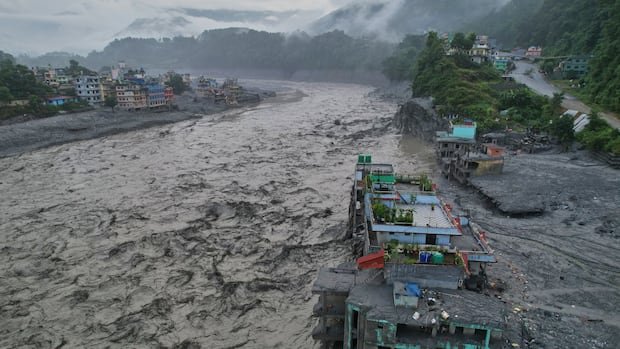
Authorities in Nepal have alerted the public about potential new flooding threats on Sunday and advised residents in flood-affected regions to stay vigilant as water levels surged in the Bhotekoshi River. Flood warnings were issued early Sunday through mobile notifications as rescue teams cleared a key highway linking Kathmandu to one of the hardest-hit areas from the catastrophic floods last Wednesday, claiming the lives of at least 800 individuals and leaving over 3,000 missing in Nepal and Tibet.
Following notifications from Chinese authorities regarding increased water flow upstream, Nepal’s National Disaster Risk Reduction and Management Authority’s CEO, Dharam Raj Uprety, confirmed the latest warnings. Chinese state media reported that a newly formed lake post-flood in the mountainous region had mostly drained, but highlighted a potential risk from a crater holding around 1.4 million cubic meters of water located 5.6 kilometers upstream, requiring continuous monitoring.
As per Nepal’s disaster agency, the death toll reached 788 with 2,502 individuals missing, while Chinese authorities reported 16 deaths and 546 missing persons on their side of the border. Among the missing are numerous individuals from various countries who were in the area for work, mountain visits, or pilgrimages. In Tibet, 261 foreigners, including over 100 Nepalis and others from different nations, were reported missing.
In a social media update, Canada’s Foreign Affairs Minister Anita Anand confirmed the safety of a previously missing Canadian and stated that 31 Canadians remain unaccounted for, with the numbers subject to change as more information surfaces. Families of the missing Canadians have been seeking assistance from the Canadian government, requesting resources like thermal and infrared cameras to aid in the search efforts in Nepal.
Rescue operations are ongoing at multiple hydroelectric projects, with a significant operation at the Upper Trishuli complex where approximately 350 individuals are feared trapped inside a tunnel. Over 10,000 Nepali troops, along with specialists from China and India, are engaged in tunnel rescue efforts. Some affected residents have started returning to their damaged homes in regions like Dhading, assessing the extent of the devastation and salvaging belongings amidst the aftermath of the floods.
The recent flooding incidents in Nepal and Tibet were triggered by a glacial collapse in the Himalayan region, causing a chain reaction of water surges that swept through communities. Nepal’s foreign affairs minister emphasized the country’s disproportionate vulnerability to climate change impacts despite its minimal contribution to global emissions. Scientists have noted the escalating risk of such disasters in the warming Himalayan mountains due to human-induced global warming, underscoring the urgent need for collective action on climate change.
Residents in flood-affected areas expressed struggles in coping with continuous alerts and challenges in accessing basic necessities following the destruction of bridges and infrastructure. The situation remains precarious as communities grapple with the aftermath of the devastating floods and the ongoing risk of further flooding incidents.