
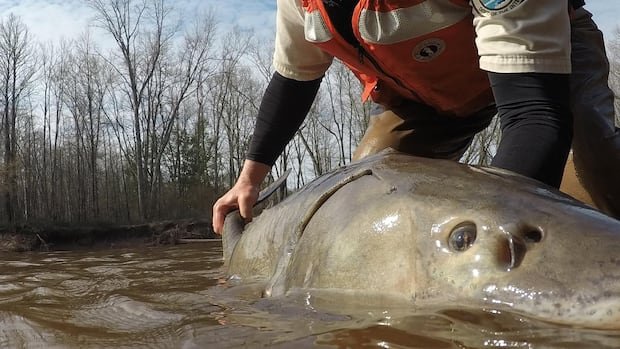
Lake sturgeon in the Great Lakes may have astonishing lifespans surpassing 400 years, according to recent research. Despite their remarkable longevity, these enormous fish, which can reach up to 180 kilograms and two meters in length, are facing endangerment in the Great Lakes region. Overfishing and habitat destruction have decimated around 99% of the historic lake sturgeon population, necessitating human intervention through raising and releasing young sturgeon to foster recovery efforts.
The study, led by Ed Baker, a fisheries scientist from the Michigan Department of Natural Resources, utilized over four decades of data on captured and recaptured lake sturgeon across the Great Lakes. Contrary to traditional estimates of a maximum lifespan of 150 years, the study suggests that some lake sturgeon could potentially live for over four centuries.
The research challenges the conventional method of aging sturgeon by counting growth rings, as the rings become more challenging to discern with age due to slow growth. Instead, Baker and his team analyzed growth data from 44 years of captures to estimate the time it would take for individual sturgeon to reach maturity.
One notable finding from the study involved a male sturgeon that only grew seven centimeters over 34 years, indicating a slow growth rate that could lead to centuries-long lifespans among some sturgeon individuals. Trevor Pitcher, a biologist at the University of Windsor, emphasized the implications of conserving a species with such extended lifespans, suggesting a need to reassess conservation strategies for the long-term benefit of lake sturgeon populations.
Pitcher highlighted the critical role sturgeon play in maintaining ecosystem balance by consuming invasive species like quagga mussels and gobies. Given the historical decline in sturgeon populations due to human activities, efforts to restore their numbers are vital to preserve the integrity of the aquatic food web.
In Anishinaabe tradition, lake sturgeon are revered as elders for their longevity and significance in the ecosystem. Perry McLeod-Shabogesic, an elder from Nipissing First Nation, emphasized the cultural importance of sturgeon as beings that transcend conventional categorizations, embodying a unique status “in between” different aspects of existence.
The study’s findings resonate with ancestral knowledge and traditional teachings, validating the deep-rooted understanding of lake sturgeon’s exceptional characteristics. McLeod-Shabogesic humorously acknowledged the scientific confirmation of sturgeon’s enduring lifespans, affirming the alignment of modern research with traditional wisdom passed down through generations.