
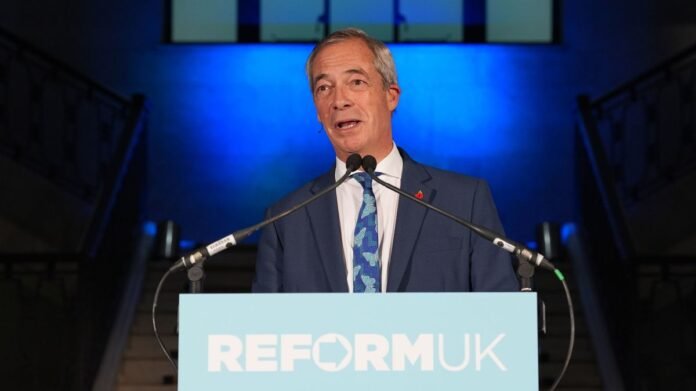
Nigel Farage has been accused of planning to make deeper cuts to public services than the Conservative Party, risking harm to pensioners, according to critics who labeled his Reform UK party as “vultures.”
During a speech in the City of London, Farage, the leader of Reform UK, abandoned several tax promises worth billions of pounds while emphasizing potential welfare reductions and a significant decrease in public spending if his party gains power. He highlighted the economic challenges and hinted at a possible general election in 2027, expressing disappointment over what he views as missed Brexit opportunities.
Farage declined to commit to maintaining the pensions triple lock system if elected, proposing potential reductions to the minimum wage for young workers. He also reiterated controversial plans to assist wealthy international business figures in avoiding taxes, drawing criticism for favoring hedge funds and financial speculators over ordinary workers.
Critics described Farage’s proposals as an “incoherent saloon bar budget” that would benefit the wealthy at the expense of workers, particularly pensioners. The Deputy Leader of the Liberal Democrats, Daisy Cooper, condemned Farage for allegedly prioritizing the interests of wealthy individuals over vulnerable pensioners and pledged to oppose Reform’s policies to safeguard pensioners.
Farage acknowledged the challenges of implementing extensive tax cuts given the current economic conditions, conceding that significant tax reductions might not be feasible at present. He reaffirmed his intention to introduce the Britannia Card, a scheme aimed at allowing wealthy foreigners to avoid certain taxes on overseas income and inheritances.
Furthermore, Farage hinted at the possibility of reducing the minimum wage for younger employees, suggesting that the current rates may be too high in light of adjustments to National Insurance Contributions. He emphasized the need for decisive action from the government on these economic matters.
Reform’s previous manifesto included commitments to tax cuts equivalent to a substantial portion of the NHS budget, proposing measures such as raising personal allowances and introducing tax exemptions for certain businesses. However, independent analysis raised concerns about the financial feasibility of Reform’s plans.
Responding to Farage’s speech, the General Secretary of the Trade Union Congress (TUC), Paul Nowak, criticized Reform as the party of austerity, warning of potential job losses and negative implications for workers’ rights and environmental standards under Farage’s leadership. Nowak accused Farage of pursuing policies that would undermine the economy and benefit wealthy supporters, likening his approach to that of former US President Donald Trump.
Various political figures, including a Labour spokesman and the Conservative Shadow Chancellor, raised objections to Farage’s proposals, characterizing them as detrimental to public services, workers, and the overall economy. They criticized Reform’s economic agenda as chaotic and potentially harmful to the country’s financial stability.
Overall, Farage’s speech and Reform’s policies have sparked intense debate and criticism from various quarters, with concerns raised about the potential impact of their proposed measures on the economy, public services, and vulnerable groups in society.