
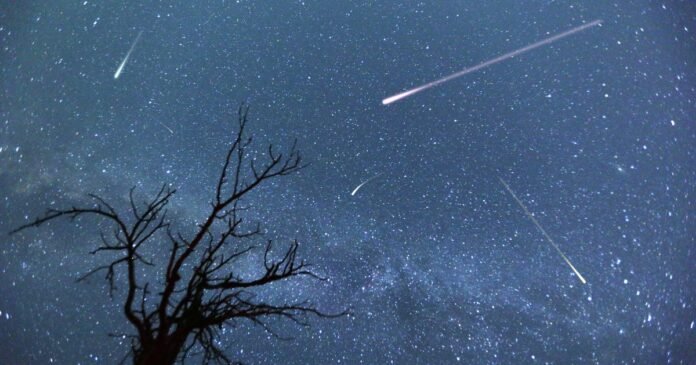
Tonight presents a prime opportunity to witness the annual Orionid meteor shower at its peak, which typically occurs between October 2 and November 7. Although the shower spans about a month, the most active viewing window is on October 21-22, as highlighted by the Royal Museums Greenwich website.
For those eager to observe the spectacle of Halley’s Comet fragments illuminating the night sky, an engineer named Chloe shared valuable insights on TikTok. Chloe emphasized that a telescope is unnecessary to enjoy the meteor show, making it accessible to all sky gazers.
The cosmic display results from Earth passing through the dusty remnants of Halley’s Comet, with tiny dust grains colliding with the atmosphere at incredible speeds, creating luminous meteor streaks. Each fleeting flash showcases the poetry of physics in action, with dust particles older than humanity igniting into brilliant light displays.
If you missed the early morning Orionid sightings on October 21, another opportunity awaits tonight. The meteor shower should be visible from midnight to dawn, with the radiant point in the Orion constellation rising just after midnight. Favorable viewing conditions are enhanced by the new moon, ensuring dark skies perfect for meteor watching.
To optimize your viewing experience, seek locations with minimal light pollution, face south or southeast towards the ascending Orion, and venture out between midnight and dawn. Allowing your eyes to adjust to the darkness for approximately 20 minutes can enhance visibility, potentially revealing up to 20 meteors per hour under optimal dark sky conditions.
The Royal Museums Greenwich website confirms that the meteor shower can be enjoyed without specialized equipment, simplifying the stargazing experience. While meteor watching can require patience, the rewards of witnessing Halley’s Comet debris lighting up the night sky are undeniably captivating.